There's a spiffy new edition of a late H.G. Wells novel, Star Begotten, that's being published by Wesleyan University Press in mid-September. Ordinarily the university library here doesn't get new books until months after publication, but the catalog's already showing a listing--"under consideration for purchase"--for this one.
Maybe I'll be able to get my hands on it some time in October. Looks as if it'd make an excellent read for Halloween.
Thursday, August 31, 2006


It was the wantonness that stirred me
When I was pregnant with my son I developed preeclampsia. The doctors determined that they'd have to take him out two months early if either of us were to make it.
He spent his first month in a neonatal intensive care unit across town before being transferred to the hospital closest to us until he'd gained enough weight to leave hospitals altogether. A NICU is, of course, a miraculous place of care and compassion, but it is also a place where much pain is experienced.
S. fought against a respirator that insisted on forcing breath in and out at a rate to which his body didn't want to conform; with his face contorting in silent screams, he was continually pricked and poked for blood samples, then transfused with fresh blood when he couldn't make enough to keep up with the amount taken (the scars on his wrists and ankles from the blood-taking did not fade away for more than a decade afterwards). Repeat.
Wired, tubed, and for several days blindered, he suffered. The painful procedures continued until eventually we--doctors, nurses, parents-- could tell that he was not only going to survive, but thrive.
Not all the babies did. There were those of two or three years of age, still in no shape to live outside NICU, abandoned by their parents, depending upon volunteers and scraps of time from the nursing staff for a bit of human contact. And there were several who lasted mere hours or days before they died.
A nurse caught me finger-stroking S.'s tiny arm on one of my first trips to the NICU. Did I not realize how much pain I was causing him? she snapped. Because he had no fat stores, the lightest touch was an assault to the nerve endings just underneath his skin. She taught me to cup my hand around him and to keep it still.
A couple weeks later I saw a new mother stroking her baby the way that I had. I waited for a nurse to correct her, but no one said a word. I knew then that her baby was going to die. No one was going to deny her the bit of comfort she could gain from touching him, even if her touch caused him distress, because these moments with the baby were going to be all that she had.
As you've maybe gathered by such an introduction, I responded to The Island of Doctor Moreau on a very personal level. If a person, if an animal, is to suffer by someone's hands in a House of Pain, it had better be for a damned good reason.
Moreau, well regarded in scientific circles in London prior to the publication of a pamphlet that exposed his cruel methods of vivisection, left England for a private island in the Pacific where he could continue his experiments outside the strictures of society. By cutting and mutilating and grafting he molds an assortment of animals into a tribe of Beast People, teaching them rudimentary language and a form of religious law designed to keep them under his control even after he has turned them out for retaining undesired animal characteristics. Imperfection really bums the man out.
Each time I dip a living creature into the bath of burning pain, I say: this time I will burn out all the animal, this time I will make a rational creature of my own.
Moreau isn't driven to mold animals into human shapes out a desire to help either man or creature, but merely because he wants "to find out the extreme limit of plasticity in a living shape." Ethics are not of interest to him: "The study of Nature makes a man at last as remorseless as Nature," he claims. Pain is immaterial; it is animalistic; intellectual desire transforms others into problems to be solved, nothing more or less.
Doctor Moreau is, in short, as psychopathic as they come despite the god-like appearance and demeanor that Well has given him.
Edward Prendick, our narrator, is no match for him. Because Prendick, a shipwrecked gentleman taking shelter on Moreau's private island, has dabbled in natural history and studied biology under the famed T.H. Huxley, Moreau eventually reveals the truth about his experiments to someone he assumes can appreciate them and will henceforth stop hindering his work due to silly behavior. Instead Prendick is horrified, but offers weak and minimal objection. He reminds me of a journalist who lands an exclusive interview and then is afraid to ask any follow-up questions to the canned nonsense he's given. Time and again I wished the narrator were someone like Patrick O'Brian's Stephen Maturin, someone who both understood the science and was willing to argue the ethics of a situation, to insist that being human means behaving humanely toward those not on your level. Someone who could at least read the Greek and Latin classics shelved near his hammock instead of revealing yet another skill he's lacking.
Poor brutes! I began to see the viler aspect of Moreau's cruelty. I had not thought before of the pain and trouble that came to these poor victims after they had passed from Moreau's hands. I had shivered only at the days of actual torment in the hands. But now that seemed to be the lesser part. Before they had been beasts, their instincts fitly adapted to their surroundings, and happy as living things may be. Now they stumbled in the shackles of humanity, lived in a fear that never died, fretted by a law they could not understand; their mock-human existence began in an agony, was one long internal struggle, one long dread of Moreau--and for what? It was the wantonness that stirred me.
Had Moreau had any intelligible object I could have sympathized at least a little with him. I am not so squeamish about pain as that. I could have forgiven him a little even had his motive been hate. But he was so irresponsible, so utterly careless. His curiosity, his mad, aimless investigations, drove him on, and the things were thrown out to live a year or so, to struggle and blunder and suffer; at last to die painfully. They were wretched in themselves, the old animal hate moved them to trouble one another, the Law held them back from a brief hot struggle and a decisive end to their natural animosities.
In these days my fear of the Beast People went the way of my personal fear of Moreau. I fell indeed into the morbid state, deep and enduring, alien to fear, which has left permanent scars upon my mind. I must confess I lost faith in the sanity of the world when I saw it suffering the painful disorder of this island. A blind fate, a vast pitiless mechanism, seemed to cut and shape the fabric of existence, and I, Moreau by his passion for research, Montgomery by his passion for drink, the Beast People, with their instincts and mental restrictions, were torn and crushed, ruthlessly, inevitably, amid the infinite complexity of its incessant wheels.
I'd like to read more H.G. Wells and I intend to return to this one again as well, possibly in a few weeks with S. My response to it next time may not be quite as visceral. Perhaps I'll see Prendick in a more appreciative light; he does makes an excellent narrator even though his passive nature infuriated me on my first reading..
He spent his first month in a neonatal intensive care unit across town before being transferred to the hospital closest to us until he'd gained enough weight to leave hospitals altogether. A NICU is, of course, a miraculous place of care and compassion, but it is also a place where much pain is experienced.
S. fought against a respirator that insisted on forcing breath in and out at a rate to which his body didn't want to conform; with his face contorting in silent screams, he was continually pricked and poked for blood samples, then transfused with fresh blood when he couldn't make enough to keep up with the amount taken (the scars on his wrists and ankles from the blood-taking did not fade away for more than a decade afterwards). Repeat.
Wired, tubed, and for several days blindered, he suffered. The painful procedures continued until eventually we--doctors, nurses, parents-- could tell that he was not only going to survive, but thrive.
Not all the babies did. There were those of two or three years of age, still in no shape to live outside NICU, abandoned by their parents, depending upon volunteers and scraps of time from the nursing staff for a bit of human contact. And there were several who lasted mere hours or days before they died.
A nurse caught me finger-stroking S.'s tiny arm on one of my first trips to the NICU. Did I not realize how much pain I was causing him? she snapped. Because he had no fat stores, the lightest touch was an assault to the nerve endings just underneath his skin. She taught me to cup my hand around him and to keep it still.
A couple weeks later I saw a new mother stroking her baby the way that I had. I waited for a nurse to correct her, but no one said a word. I knew then that her baby was going to die. No one was going to deny her the bit of comfort she could gain from touching him, even if her touch caused him distress, because these moments with the baby were going to be all that she had.
As you've maybe gathered by such an introduction, I responded to The Island of Doctor Moreau on a very personal level. If a person, if an animal, is to suffer by someone's hands in a House of Pain, it had better be for a damned good reason.
Moreau, well regarded in scientific circles in London prior to the publication of a pamphlet that exposed his cruel methods of vivisection, left England for a private island in the Pacific where he could continue his experiments outside the strictures of society. By cutting and mutilating and grafting he molds an assortment of animals into a tribe of Beast People, teaching them rudimentary language and a form of religious law designed to keep them under his control even after he has turned them out for retaining undesired animal characteristics. Imperfection really bums the man out.
Each time I dip a living creature into the bath of burning pain, I say: this time I will burn out all the animal, this time I will make a rational creature of my own.
Moreau isn't driven to mold animals into human shapes out a desire to help either man or creature, but merely because he wants "to find out the extreme limit of plasticity in a living shape." Ethics are not of interest to him: "The study of Nature makes a man at last as remorseless as Nature," he claims. Pain is immaterial; it is animalistic; intellectual desire transforms others into problems to be solved, nothing more or less.
Doctor Moreau is, in short, as psychopathic as they come despite the god-like appearance and demeanor that Well has given him.
Edward Prendick, our narrator, is no match for him. Because Prendick, a shipwrecked gentleman taking shelter on Moreau's private island, has dabbled in natural history and studied biology under the famed T.H. Huxley, Moreau eventually reveals the truth about his experiments to someone he assumes can appreciate them and will henceforth stop hindering his work due to silly behavior. Instead Prendick is horrified, but offers weak and minimal objection. He reminds me of a journalist who lands an exclusive interview and then is afraid to ask any follow-up questions to the canned nonsense he's given. Time and again I wished the narrator were someone like Patrick O'Brian's Stephen Maturin, someone who both understood the science and was willing to argue the ethics of a situation, to insist that being human means behaving humanely toward those not on your level. Someone who could at least read the Greek and Latin classics shelved near his hammock instead of revealing yet another skill he's lacking.
Poor brutes! I began to see the viler aspect of Moreau's cruelty. I had not thought before of the pain and trouble that came to these poor victims after they had passed from Moreau's hands. I had shivered only at the days of actual torment in the hands. But now that seemed to be the lesser part. Before they had been beasts, their instincts fitly adapted to their surroundings, and happy as living things may be. Now they stumbled in the shackles of humanity, lived in a fear that never died, fretted by a law they could not understand; their mock-human existence began in an agony, was one long internal struggle, one long dread of Moreau--and for what? It was the wantonness that stirred me.
Had Moreau had any intelligible object I could have sympathized at least a little with him. I am not so squeamish about pain as that. I could have forgiven him a little even had his motive been hate. But he was so irresponsible, so utterly careless. His curiosity, his mad, aimless investigations, drove him on, and the things were thrown out to live a year or so, to struggle and blunder and suffer; at last to die painfully. They were wretched in themselves, the old animal hate moved them to trouble one another, the Law held them back from a brief hot struggle and a decisive end to their natural animosities.
In these days my fear of the Beast People went the way of my personal fear of Moreau. I fell indeed into the morbid state, deep and enduring, alien to fear, which has left permanent scars upon my mind. I must confess I lost faith in the sanity of the world when I saw it suffering the painful disorder of this island. A blind fate, a vast pitiless mechanism, seemed to cut and shape the fabric of existence, and I, Moreau by his passion for research, Montgomery by his passion for drink, the Beast People, with their instincts and mental restrictions, were torn and crushed, ruthlessly, inevitably, amid the infinite complexity of its incessant wheels.
I'd like to read more H.G. Wells and I intend to return to this one again as well, possibly in a few weeks with S. My response to it next time may not be quite as visceral. Perhaps I'll see Prendick in a more appreciative light; he does makes an excellent narrator even though his passive nature infuriated me on my first reading..
Tuesday, August 29, 2006
WILLIAMS: We always talk about what you're reading. As you know, there was a report that you just read the works of a French philosopher. (Bush laughs)
BUSH: The Stranger.
WILLIAMS: Tell us the back story of Camus.
BUSH: The back story of the the book?
WILLIAMS: What led you to...
BUSH: I was in Crawford and I said I was looking for a book to read and Laura said you oughtta try Camus, I also read three Shakespeare's.
WILLIAMS: This is a change...
BUSH: Not really. Wait a minute.
WILLIAMS: A few months ago you were reading the life story of Joe DiMaggio by Richard Ben Cramer.
BUSH: Which was a good book.
WILLIAMS: You've been on a Teddy Roosevelt reading kick.
BUSH: Well, I'm reading about the battle of New Orleans right now. I’ve got an eclectic reading list.
WILLIAMS: And now Camus?
BUSH: Well, that was a couple of books ago. Let me look. The key for me is to keep expectations low.
Full transcript here. Bush's summer reading list here. That's more books than I read this summer and I only work part-time.
BUSH: The Stranger.
WILLIAMS: Tell us the back story of Camus.
BUSH: The back story of the the book?
WILLIAMS: What led you to...
BUSH: I was in Crawford and I said I was looking for a book to read and Laura said you oughtta try Camus, I also read three Shakespeare's.
WILLIAMS: This is a change...
BUSH: Not really. Wait a minute.
WILLIAMS: A few months ago you were reading the life story of Joe DiMaggio by Richard Ben Cramer.
BUSH: Which was a good book.
WILLIAMS: You've been on a Teddy Roosevelt reading kick.
BUSH: Well, I'm reading about the battle of New Orleans right now. I’ve got an eclectic reading list.
WILLIAMS: And now Camus?
BUSH: Well, that was a couple of books ago. Let me look. The key for me is to keep expectations low.
Full transcript here. Bush's summer reading list here. That's more books than I read this summer and I only work part-time.
Some bone she chews in secret
Stefanie posted Virginia Woolf's description of H.G. Wells and his wife Amy (who he preferred to call Jane) last night:
I could see from the plaintive watery look on Mrs. Wells' face (she has widely spaced teeth & in repose looks very worried, at the same time vacant) that he is arrogant lustful & bullying in private life.
Based on what I've read about Wells in Victoria Glendinning's bio of Rebecca West and in Gordon N. Ray's H.G. Wells and Rebecca West that sounds awfully insightful. But after the birth of their two sons Wells turned his lustfulness outside the marriage, depending on Jane to keep the home and manage the books while he focused on more important matters. He had a string of lovers (he kept Jane well-informed on his conquests; she only pretended to be in the dark about his philandering), and a ten-year relationship and a son with West (early in their relationship, in a moment of anger, afraid that Rebecca might leave him, he "intentionally omitted his usual precautions in the hope that pregnancy might bind her to him").
The Slaves of Golconda will be discussing Wells' The Island of Doctor Moreau tomorrow; today I want to provide Woolf's impression of West (Wells' name comes up a time or two).
According to Glendinning, Woolf and West first met in Chelsea at a lunch in the home of Dorothy Todd and Madge Garland in 1928 (West and Wells had separated for the last time five years earlier; she'd marry banker Henry Andrews in 1930). Writing to sister Vanessa Bell, Woolf said
Rebecca was much the most interesting, though as hard as nails, very distrustful, and no beauty. She is a cross between a charwoman and a gipsy, but as tenacious as a terrier, with flashing eyes, very shabby, rather dirty nails, immense vitality, bad taste, suspicion of intellectuals, and great intelligence.
After a second meeting, Woolf described West as looking as if she "has some bone she chews in secret, perhaps about having a child by Wells." Still later, in a letter to Lady Ottoline Morrell at the end of 1933, Woolf said
R's great point is her tenacious and muscular mind, and all her difficulty comes from the wheals [sic] and scars left by the hoofmarks of Wells.
Woolf didn't much care for West's husband --"such dead, though excellent, mutton," she said--and disliked elegant Orchard Court, their home, complaining to Anne Oliver Bell of "the formality, the social strata they live on--appearances." West, who'd been humiliated by and exiled from respectable society for too long due to her relationship with Wells, often gave dinner parties strictly for Henry's friends in the business world. She didn't want a life limited to only a Bloomsbury group.
Although the women never developed a close personal connection, West contributed an essay, Letters to a Grandfather, to the Hogarth Letters series of pamphlets that Virginia and Leonard Woolf published in the Thirties. West reviewed Woolf's Orlando in the New York Herald Tribune, calling it "a poetic masterpiece of the first rank."
I could see from the plaintive watery look on Mrs. Wells' face (she has widely spaced teeth & in repose looks very worried, at the same time vacant) that he is arrogant lustful & bullying in private life.
Based on what I've read about Wells in Victoria Glendinning's bio of Rebecca West and in Gordon N. Ray's H.G. Wells and Rebecca West that sounds awfully insightful. But after the birth of their two sons Wells turned his lustfulness outside the marriage, depending on Jane to keep the home and manage the books while he focused on more important matters. He had a string of lovers (he kept Jane well-informed on his conquests; she only pretended to be in the dark about his philandering), and a ten-year relationship and a son with West (early in their relationship, in a moment of anger, afraid that Rebecca might leave him, he "intentionally omitted his usual precautions in the hope that pregnancy might bind her to him").
The Slaves of Golconda will be discussing Wells' The Island of Doctor Moreau tomorrow; today I want to provide Woolf's impression of West (Wells' name comes up a time or two).
According to Glendinning, Woolf and West first met in Chelsea at a lunch in the home of Dorothy Todd and Madge Garland in 1928 (West and Wells had separated for the last time five years earlier; she'd marry banker Henry Andrews in 1930). Writing to sister Vanessa Bell, Woolf said
Rebecca was much the most interesting, though as hard as nails, very distrustful, and no beauty. She is a cross between a charwoman and a gipsy, but as tenacious as a terrier, with flashing eyes, very shabby, rather dirty nails, immense vitality, bad taste, suspicion of intellectuals, and great intelligence.
After a second meeting, Woolf described West as looking as if she "has some bone she chews in secret, perhaps about having a child by Wells." Still later, in a letter to Lady Ottoline Morrell at the end of 1933, Woolf said
R's great point is her tenacious and muscular mind, and all her difficulty comes from the wheals [sic] and scars left by the hoofmarks of Wells.
Woolf didn't much care for West's husband --"such dead, though excellent, mutton," she said--and disliked elegant Orchard Court, their home, complaining to Anne Oliver Bell of "the formality, the social strata they live on--appearances." West, who'd been humiliated by and exiled from respectable society for too long due to her relationship with Wells, often gave dinner parties strictly for Henry's friends in the business world. She didn't want a life limited to only a Bloomsbury group.
Although the women never developed a close personal connection, West contributed an essay, Letters to a Grandfather, to the Hogarth Letters series of pamphlets that Virginia and Leonard Woolf published in the Thirties. West reviewed Woolf's Orlando in the New York Herald Tribune, calling it "a poetic masterpiece of the first rank."
Monday, August 28, 2006
Turning H.G. Wells' spine to the wall
She was beginning to feel quite cheerful. The man at the other table, right across the other side of the room, was staring at her. She stared back and he dropped his eyes. That done, she decided to have a little read of her book. She was reading a novel by Virginia Woolf--The Years. One had to be so careful what one read on journeys, because the book would forever bear the mark of the journey, so she always tried to read something not too important but not too trivial either. She remembered reading a volume of short stories by Wells--why, she couldn't remember--while waiting for Karel to arrive at some incredibly elaborate and doubtful assignation, and the book had been ruined forever: she had to turn its spine to the wall nowadays so she couldn't read its lettering. And while one of the children had been having his appendix out, she had read Iris Murdoch. On a train, when she had just left her husband forever, she had read Mr. Norris Changes Trains. Crying, turning the pages, gazing out of the window, crying again, reading a few more pages. Just like now, in fact. The soup plate and the filling were removed by the proprietor's sulky daughter, the omelette arrived.
--Margaret Drabble, The Realms of Gold
--Margaret Drabble, The Realms of Gold
Sunday, August 27, 2006
Friday afternoon I was overcome by an urge to order not one, but two, Stendhal novels. I've been entertaining the idea of reading The Red and the Black for several months; it seemed reasonable to go on and purchase The Charterhouse of Parma as well, especially since it's the book an ill Karel Schmidt pleads to be rescued from (he's provided with a Kingsley Amis) near the end of Margaret Drabble's The Realms of Gold and I've had it in the back of my mind since I first read the Drabble in the late 70s.
I told myself these would be my last purchases for awhile. Then I happened upon a 25-cent The Ox-Bow Incident on the used book cart at the public library Saturday morning and then later found hardback copies of David Lodge's The Art of Fiction and Leslie Marmon Silko's Almanac of the Dead when I ventured into Goodwill on my walk to the post office to return our latest Netflix offering (David Duchovny's House of D, which we all enjoyed). And a heavily annotated paperback Camus, one I already have, because the margin notes intrigued me (I resisted the Sharyn McCrumb inscribed to the "cosmic possum.") Those are my last. What else could I possibly need that I don't already have?
But speaking of Goodwill, it's not one of my usual haunts for used books. R. and her best friend were obsessed with Goodwill for several years, to the point that I'd have to drop them off there after picking them up from school in the afternoons two or three times a week. I found a hardback copy of a Margaret Atwood there once, but even that wasn't enough to make me want to go in the store--too many scented items that set off my allergies. It just wasn't worth it.
The store didn't smell on Saturday, though, and I enjoyed browsing in the books at the back of the store. I recognized one I'm sure my parents had on their shelves by the font on its dust jacket and it made me happy to see it because it's a book I definitely don't want to read.
See, when I was growing up my parents had a wall of hardback books back behind the television set. No one ever took one of these books down for perusual that I ever saw, although on occasion my mother or my sister (15 years older than me) would attempt to put some Peyton Place-type paperback beyond my reach and attention on the top shelf (did they not think that I knew how to stand on top of the TV to reach them?). I developed quite a pronounced disdain for all the books on those shelves and I would never have deigned to read a one of them.
But after my sister moved back home after her husband's death, she boxed up all those books (and a lot of mine) and placed them behind many many boxes of items from her own home. She filled the shelves behind the TV with framed photos and knicknacks.
The past few years I've second-guessed my early opinion--maybe some of the books my parents owned, most from the 50's or early 60's, I'd say, were actually better than I'd thought. Maybe I'd recognize some of the authors and want to give the books a try if my sister could remember where in the basement she stashed them. (Or own up to the fact that she gave them away, instead of continually promising to unearth them for me at a later date.)
I can't call recognizing the font on an old book in Goodwill a full Proustian experience since I can't recall the titles of all the other books my parents owned, but it does help put the loss of them in perspective.
I told myself these would be my last purchases for awhile. Then I happened upon a 25-cent The Ox-Bow Incident on the used book cart at the public library Saturday morning and then later found hardback copies of David Lodge's The Art of Fiction and Leslie Marmon Silko's Almanac of the Dead when I ventured into Goodwill on my walk to the post office to return our latest Netflix offering (David Duchovny's House of D, which we all enjoyed). And a heavily annotated paperback Camus, one I already have, because the margin notes intrigued me (I resisted the Sharyn McCrumb inscribed to the "cosmic possum.") Those are my last. What else could I possibly need that I don't already have?
But speaking of Goodwill, it's not one of my usual haunts for used books. R. and her best friend were obsessed with Goodwill for several years, to the point that I'd have to drop them off there after picking them up from school in the afternoons two or three times a week. I found a hardback copy of a Margaret Atwood there once, but even that wasn't enough to make me want to go in the store--too many scented items that set off my allergies. It just wasn't worth it.
The store didn't smell on Saturday, though, and I enjoyed browsing in the books at the back of the store. I recognized one I'm sure my parents had on their shelves by the font on its dust jacket and it made me happy to see it because it's a book I definitely don't want to read.
See, when I was growing up my parents had a wall of hardback books back behind the television set. No one ever took one of these books down for perusual that I ever saw, although on occasion my mother or my sister (15 years older than me) would attempt to put some Peyton Place-type paperback beyond my reach and attention on the top shelf (did they not think that I knew how to stand on top of the TV to reach them?). I developed quite a pronounced disdain for all the books on those shelves and I would never have deigned to read a one of them.
But after my sister moved back home after her husband's death, she boxed up all those books (and a lot of mine) and placed them behind many many boxes of items from her own home. She filled the shelves behind the TV with framed photos and knicknacks.
The past few years I've second-guessed my early opinion--maybe some of the books my parents owned, most from the 50's or early 60's, I'd say, were actually better than I'd thought. Maybe I'd recognize some of the authors and want to give the books a try if my sister could remember where in the basement she stashed them. (Or own up to the fact that she gave them away, instead of continually promising to unearth them for me at a later date.)
I can't call recognizing the font on an old book in Goodwill a full Proustian experience since I can't recall the titles of all the other books my parents owned, but it does help put the loss of them in perspective.
Friday, August 25, 2006
The Startle Puss
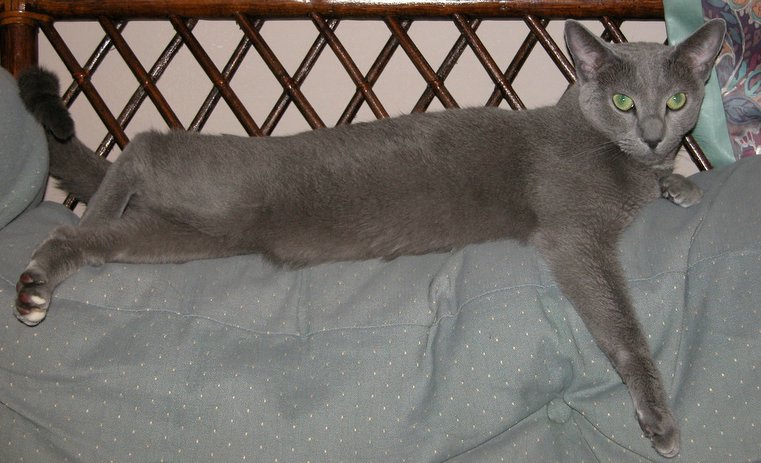
Claudius is the weirdest cat we've ever had. Rattle a few forks into the dishwasher and he hightails it from the room. Sneeze and he'll send his food dish skittering across the floor in his haste to save himself from imminent danger. He'll insist that you turn the faucet on but before he drinks he has to check half a dozen times for something sneaking up behind him.
Remember, he spent 36 days under the couch last fall after Ellie came to live with us.
Currently he is afraid to go downstairs (we cleaned the carpet in the family room three weeks ago) and I'm having to cater all his meals upstairs.
Once he settles in for his afternoon nap, though, his startle relex takes a hike. Nothing scares him then and he lets it be known that he thinks you're an idiot for thinking that it might.
Remember to check out The Friday Ark and the Carnival of the Cats at Catymology on Sunday.
Subscribe to:
Posts (Atom)
-
Last night I read Julian Barnes' The Sense of an Ending . Yes, the night before it went up against Donald Ray Pollock's The Devil Al...
-
As I said on New Year's Day, one of my projects for the year is to keep track of all the reading done by the characters in the fiction t...
-
 Anthony Trollope's 200th birthday takes place on April 24, and Karen at Books and Chocolate is hosting an Anthony Trollope Bicenntenni...
