Woo hoo! The prodigal daughter is finally back on American soil.
Unfortunately, someone in the baggage department in London removed several books from her luggage and she's up in Boston right now, before the final leg of her journey home, fuming over their loss (one was a textbook that cost more than $100), as anyone who'd purchased 35 new books over the summer would be.
But she's back, safe, and we've already located the necessary complaint form on line.
Have a great weekend, everyone!
Friday, August 18, 2006


Thursday, August 17, 2006
A head like a bocce ball???
I generally consider myself a generous reader. I don't consider it a personal affront if a book isn't perfect, or dwell on its flaws when there's something positive to focus on, and I'd much rather bail on a book that I'm not enjoying on some level than stick with it so I can lambaste it from start to finish.
I mentioned earlier that I was having some issues reading Ron Suskind's The One Percent Doctrine. By the second chapter I was already bothered by Suskind's tendency to provide direct quotations from conversations he himself had obviously never heard. Who gave him these quotes? Why? Were these conversations taped? Remembered? Spun?
Still, I'd read many interesting things about this one and I told myself I could overlook the lack of attribution so that I could at least gain a sense of what the "war against terrorism" looks like from within the Bush administration. And who am I to go all Princess-and-the-Pea over some scene-setting inconsequential words that no one would ever have remembered precisely anyway? Suskind's won a Pulitzer; surely I can deign to read him. I have to accept that this type of book can't by its very nature provide the attribution I'd prefer.
But then I reach chapter four.
Chapter four is entitled "Zawahiri's Head" and the first section is focused on the agent responsible for transporting a jawless head, dug up from a riverbed in Afganistan and sent to Washington so that a $25 million bounty on Ayman al-Zawahiri might be claimed, from Dulles Airport to the FBI evidence lab. Because I put the index to use I learn this agent's going to be regarded as a hero within the FBI later in the book (and suffer tooth ache to boot), but at this point the amount of focus on Dan Coleman seems out of place, mere padding: why does the reader need to know of his early morning musings and angst, his book-on-tape habit, his every flitting thought? Isn't it enough to know his son's an Army Ranger in Kandahar?
And then I reach this part six pages into the chapter and know I won't be able to continue:
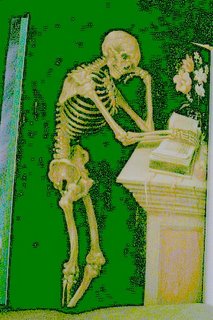
He peeled off the top, reached his hand into the cool, moist darkness, pushed his fingers down through a bed of river mud, and lifted out the skull, a bit of skin still left around the crown.
It felt like a boccie ball. He held it upright in his palm, as Hamlet did with Yorick's. The three men looked at it, appraisingly, and all saw it at the same instant: in the middle of the forehead, the eyeless head showed an indentation. It was unmistakable: the spot where Zawahiri had a dark callus, a mark of piety, of humility, from countless hours of prostration, his head pressed to stone, concrete, wood, or simply dirt, as he committed his life to the will of Allah.
I mentioned earlier that I was having some issues reading Ron Suskind's The One Percent Doctrine. By the second chapter I was already bothered by Suskind's tendency to provide direct quotations from conversations he himself had obviously never heard. Who gave him these quotes? Why? Were these conversations taped? Remembered? Spun?
Still, I'd read many interesting things about this one and I told myself I could overlook the lack of attribution so that I could at least gain a sense of what the "war against terrorism" looks like from within the Bush administration. And who am I to go all Princess-and-the-Pea over some scene-setting inconsequential words that no one would ever have remembered precisely anyway? Suskind's won a Pulitzer; surely I can deign to read him. I have to accept that this type of book can't by its very nature provide the attribution I'd prefer.
But then I reach chapter four.
Chapter four is entitled "Zawahiri's Head" and the first section is focused on the agent responsible for transporting a jawless head, dug up from a riverbed in Afganistan and sent to Washington so that a $25 million bounty on Ayman al-Zawahiri might be claimed, from Dulles Airport to the FBI evidence lab. Because I put the index to use I learn this agent's going to be regarded as a hero within the FBI later in the book (and suffer tooth ache to boot), but at this point the amount of focus on Dan Coleman seems out of place, mere padding: why does the reader need to know of his early morning musings and angst, his book-on-tape habit, his every flitting thought? Isn't it enough to know his son's an Army Ranger in Kandahar?
And then I reach this part six pages into the chapter and know I won't be able to continue:
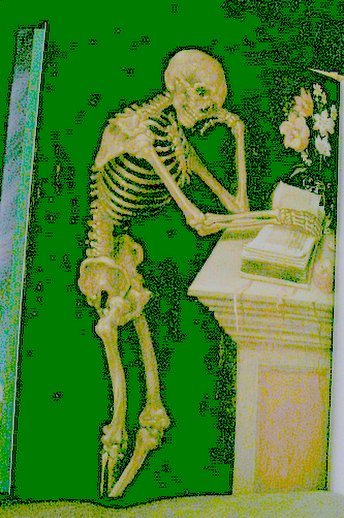
He peeled off the top, reached his hand into the cool, moist darkness, pushed his fingers down through a bed of river mud, and lifted out the skull, a bit of skin still left around the crown.
It felt like a boccie ball. He held it upright in his palm, as Hamlet did with Yorick's. The three men looked at it, appraisingly, and all saw it at the same instant: in the middle of the forehead, the eyeless head showed an indentation. It was unmistakable: the spot where Zawahiri had a dark callus, a mark of piety, of humility, from countless hours of prostration, his head pressed to stone, concrete, wood, or simply dirt, as he committed his life to the will of Allah.
A head like a bocce ball? A grown man's head, particularly one missing a jaw, would feel nothing like a bocce ball and it certainly wouldn't look like one either.
Did Coleman tell Suskind a mud-covered skull felt like a bocce ball or is this absurd figure of speech one that Suskind's responsible for? Why use a variant spelling of bocce instead of the official one? And who thought up the Hamlet reference? Alas, Yorick, did anyone stop to consider that fencing was Hamlet's sport of choice?
Clearly, by this point any spirit of generosity had left me entirely. I could have continued if Suskind had left out the simile. I could have continued if the absurdity had contained a bit of explanation: perhaps, "It felt like a bocce ball, Dan thought wildly," or "Close proximity to a presumed terrorist's skull made Dan uncharacteristically illogical: It felt like a bocce ball flashed through his head."
So Suskind goes back to the library because he wrote too quickly and I go back to Proust who did not.
The people behind me on the waiting list will thank me.

Just before it was dark, as they passed a great island of Sargasso weed that heaved and swung in the light sea as though the ocean were making love with something under a yellow blanket, his small line was taken by a dolphin. He saw it first when it jumped in the air, true gold in the last of the sun and bending and flapping wildly in the air.
--Ernest Hemingway, The Old Man and the Sea
The guys went deep sea fishing Tuesday and came home yesterday with a cooler full of dolphin. S. is now writing his story of the trip; next week he'll be reading Santiago's.
Wednesday, August 16, 2006
New books!

This month it's all about the stockpiling.
I now own all of Rebecca West's novels. Ella, who is purging her collection before a move overseas, sent me West's autobiographical trilogy: The Fountain Overflows, This Real Night,
and Cousin Rosamund. Thank you kindly, Ella!
I ordered The Birds Fall Down, West's political thriller, from Amazon in the UK since it's out of print here; keeping it company in its package was Margaret Drabble's latest, The Sea Lady. I've since learned that West did not care for Drabble at all--that may very well explain why the box was on the verge of breaking apart when I received it. Henceforth I shall take care to keep these books separated.
And I finally received The Harsh Voice, West's collection of novellas, which evidently went astray on other adventures before its delayed arrival here.
Also new: Peter Boxall's 1001 Books You Must Read Before You Die, which I decided I had to own; Laurence Sterne's A Sentimental Journey; and a 99 cent copy of Clair Huffaker's The Cowboy and the Cossack.
Since the photo op above I've received Carl Rollyson's Rebecca West and the God that Failed, a book of essays written after Rollyson had completed his biography on West; and Christina Stead's The Man Who Loved Children, which I read years ago and want to return to.
Still on order: Christina Stead's Letty Fox; Nick Hornby's Housekeeping vs. the Dirt; and for S., since he enjoyed Catch-22 so much, a copy of One Flew Over the Cuckoo's Nest.
Fall releases I've placed on hold at the public library:
Kate Atkinson's One Good Turn
Francine Prose's Reading Like a Writer
Susanna Clarke's The Ladies of Grace Adieu and Other Stories
Alice Munro's View from Castle Rock
Charles Frazier's Thirteen Moons
Margaret Atwood's Moral Disorder
Richard Power's The Echo Maker
Sunday, August 13, 2006
Elementary Consideration
An essay in Rebecca West's Ending in Earnest: A Literary Log:
Those critics who dislike those who were given ten talents in their napkins because they have nothing in their own but holes, often accuse a book of abundance and intricacy as if these were vices: as if an author had no right to demand anything but a minimum of a reader's time and attention. Yet literature is in this matter legitimately entitled to make exactly the same demands as painting and music.
If a person standing in front of Botticelli's Birth of Venus should say, "Look here, there are far too many things in this picture. I find it far too great a strain to absorb the whiteness of Venus, and the twining of the two wind spirits in the sky, and the pattern on the robe of the nymph who steps forward to clothe the goddess, and the flowers underfoot and the two stars low on the horizon that are foundering under the inrush of day, and the little bays where it is still nearly night and the water is still dark and cold. The artist ought to have restricted himself to the representation of fewer objects," we should answer, "But you are talking very preposterous nonsense. There are certainly a great many things in this picture, but they are all beautiful things, and if you stand there and look at it in the proper spirit, thanking God for your luck in being able to do so, maybe He will let you see the whole which the painter has made out of all these component parts."
If a person should say at a performance of Don Giovanni, "I don't like this, the music keeps on changing keys, and it's all broken up into different airs, and you never know where you are because the airs keep on coming back and repeating themselves," we would say coldly, "It is evident that you are not musical. What you say of this performance is simply a melancholy and not interesting record of your own deficiencies."
But to any ass who says, "This book is too full of brilliant things and beautiful phrases," or, "I find this book too complicated in its design because its events do not follow the same sequence as in life, and establish relationships that are subtler than those which are commonly the subject of general conversation in a liner smoking room or a women's club party," we extend a tolerance that he does not deserve.
It is generally recognized that a picture need not take for its subject an apple on a plate, though some good pictures have done so, and that a sonata need not be written in the key of C major and two-four time and the mood of "Lilla's a Lady," though some good music has dared it. But it is not generally enough recognized that literature need not, neither in treatment nor in subject, be for the tiny tots.
A book cannot be too full of brilliant and beautiful phrases; but somebody may be reading it too quickly to absorb them. A book cannot have too complicated a design if it is significant; but somebody may be too dull witted to comprehend any design more complicated than a triangle. Let such somebodies go and become cooks at Childs and cease to intervene in literary matters. I am not saying that there is no such thing as an over-ornate style; but that has nothing to do with an abundance of beautiful and brilliant phrases; it has to do with an abundance of phrases that cannot be described as beautiful and brilliant since they are not significant and relevant. Neither an I saying that there is no such thing as bad design; but badness of design is far from being the same thing as complication. Ask Botticelli. Ask Bach. Ask Donne or Dante.
Those critics who dislike those who were given ten talents in their napkins because they have nothing in their own but holes, often accuse a book of abundance and intricacy as if these were vices: as if an author had no right to demand anything but a minimum of a reader's time and attention. Yet literature is in this matter legitimately entitled to make exactly the same demands as painting and music.
If a person standing in front of Botticelli's Birth of Venus should say, "Look here, there are far too many things in this picture. I find it far too great a strain to absorb the whiteness of Venus, and the twining of the two wind spirits in the sky, and the pattern on the robe of the nymph who steps forward to clothe the goddess, and the flowers underfoot and the two stars low on the horizon that are foundering under the inrush of day, and the little bays where it is still nearly night and the water is still dark and cold. The artist ought to have restricted himself to the representation of fewer objects," we should answer, "But you are talking very preposterous nonsense. There are certainly a great many things in this picture, but they are all beautiful things, and if you stand there and look at it in the proper spirit, thanking God for your luck in being able to do so, maybe He will let you see the whole which the painter has made out of all these component parts."
If a person should say at a performance of Don Giovanni, "I don't like this, the music keeps on changing keys, and it's all broken up into different airs, and you never know where you are because the airs keep on coming back and repeating themselves," we would say coldly, "It is evident that you are not musical. What you say of this performance is simply a melancholy and not interesting record of your own deficiencies."
But to any ass who says, "This book is too full of brilliant things and beautiful phrases," or, "I find this book too complicated in its design because its events do not follow the same sequence as in life, and establish relationships that are subtler than those which are commonly the subject of general conversation in a liner smoking room or a women's club party," we extend a tolerance that he does not deserve.
It is generally recognized that a picture need not take for its subject an apple on a plate, though some good pictures have done so, and that a sonata need not be written in the key of C major and two-four time and the mood of "Lilla's a Lady," though some good music has dared it. But it is not generally enough recognized that literature need not, neither in treatment nor in subject, be for the tiny tots.
A book cannot be too full of brilliant and beautiful phrases; but somebody may be reading it too quickly to absorb them. A book cannot have too complicated a design if it is significant; but somebody may be too dull witted to comprehend any design more complicated than a triangle. Let such somebodies go and become cooks at Childs and cease to intervene in literary matters. I am not saying that there is no such thing as an over-ornate style; but that has nothing to do with an abundance of beautiful and brilliant phrases; it has to do with an abundance of phrases that cannot be described as beautiful and brilliant since they are not significant and relevant. Neither an I saying that there is no such thing as bad design; but badness of design is far from being the same thing as complication. Ask Botticelli. Ask Bach. Ask Donne or Dante.
Wednesday, August 09, 2006
Years ago L.'s mother started putting gifts other than eggs and chocolate bunnies in our Easter baskets. L. would get a book and I would get dish towels.
You think you know where this story is going, don't you?
Actually, I love the tradition of getting fresh new dish towels every spring and would be sorely disappointed if our basket were to turn out to be towel-free one year. It was the books that turned out to be the bum steer.
At first the books were the mass market best seller type of thing that I could picture L.'s sister's husband reading. I read one once, told L. it was about a sociopath who murdered women and then wore their skins. Why, he asked, did his mother think he'd want to read about that?
Because it's not that easy to find Thomas Hardy in the bookstore in our hometown?
The books would usually be offered up at the annual neighborhood yard sale.
After a few years, my mother-in-law switched to giving L. the latest hardback political best seller. Neither of us could ever muster enough enthusiasm to attempt reading any of them and I found that used bookstores generally aren't interested in taking them off sellers' hands since they have such a short shelf-life. I believe there's still a pile of them somewhere in the garage waiting to go to Good Will.
Last year I got smart and exchanged the political offering at the bookstore the week after Easter. I think I must have even mustered the courage to tell L.'s mom that he flat out wouldn't read any of these books; this year there was no book in the basket, although I didn't pay attention to what he got in its place. A Lowe's gift card, maybe?
But the reason I've told you the above now instead of at Easter time is because I am now reading a political book, Ron Suskind's The One Percent Doctrine. I'm two chapters in and at this point it's making me feel rather itchy. I'm craving end notes and attribution for all these direct quotations from conversations that Suskind certainly wasn't privy to.
I'm going to give it one more chapter; if I haven't adjusted to the style by then, it's going back to the library.
I'm so glad it came from the library.
You think you know where this story is going, don't you?
Actually, I love the tradition of getting fresh new dish towels every spring and would be sorely disappointed if our basket were to turn out to be towel-free one year. It was the books that turned out to be the bum steer.
At first the books were the mass market best seller type of thing that I could picture L.'s sister's husband reading. I read one once, told L. it was about a sociopath who murdered women and then wore their skins. Why, he asked, did his mother think he'd want to read about that?
Because it's not that easy to find Thomas Hardy in the bookstore in our hometown?
The books would usually be offered up at the annual neighborhood yard sale.
After a few years, my mother-in-law switched to giving L. the latest hardback political best seller. Neither of us could ever muster enough enthusiasm to attempt reading any of them and I found that used bookstores generally aren't interested in taking them off sellers' hands since they have such a short shelf-life. I believe there's still a pile of them somewhere in the garage waiting to go to Good Will.
Last year I got smart and exchanged the political offering at the bookstore the week after Easter. I think I must have even mustered the courage to tell L.'s mom that he flat out wouldn't read any of these books; this year there was no book in the basket, although I didn't pay attention to what he got in its place. A Lowe's gift card, maybe?
But the reason I've told you the above now instead of at Easter time is because I am now reading a political book, Ron Suskind's The One Percent Doctrine. I'm two chapters in and at this point it's making me feel rather itchy. I'm craving end notes and attribution for all these direct quotations from conversations that Suskind certainly wasn't privy to.
I'm going to give it one more chapter; if I haven't adjusted to the style by then, it's going back to the library.
I'm so glad it came from the library.
Tuesday, August 08, 2006
"Black Lamb and Grey Falcon is digressive and meandering - you never know what's going to happen next - but this is not to say that it is shapeless. It may sprawl - it is sprawling - but remember, for a start, how what is offered as an account of a single journey has in fact been stitched seamlessly together from three separate trips. Over time we have grown familiar with the complex organisation of works such as Bleak House or Ulysses; in contemporary fiction we admire the intricate interweaving of plot, character and themes in the novels of Ian McEwan. Making different demands on the reader's expectations of order, Black Lamb and Grey Falcon has the unity and fluidity of a sustained improvisation in prose. As with a saxophonist or trumpeter, the controlling factor, the thing that allows West to range so widely without ever losing her way, is tone. The book's bold demonstration of the way that tone can take over some of the load-bearing work of structure is crucial to its innovatory importance. Within an overall constancy of tone West moves easily between registers."
The Guardian provides an edited version of Geoff Dyer's introduction to the new edition of Rebecca West's magnum opus.
The Guardian provides an edited version of Geoff Dyer's introduction to the new edition of Rebecca West's magnum opus.
Subscribe to:
Posts (Atom)
-
Last night I read Julian Barnes' The Sense of an Ending . Yes, the night before it went up against Donald Ray Pollock's The Devil Al...
-
As I said on New Year's Day, one of my projects for the year is to keep track of all the reading done by the characters in the fiction t...
-
 Anthony Trollope's 200th birthday takes place on April 24, and Karen at Books and Chocolate is hosting an Anthony Trollope Bicenntenni...
