As we grow older and see the ends of stories as well as their beginnings, we realize that to the people who take part in them it is almost of greater importance that they should be stories, that they should form a recognizable pattern, than that they should be happy or tragic. The men and women who are withered by their fates, who go down to death reluctantly but without noticeable regrets for life, are not those who have lost their mates prematurely or by perfidy, or who have lost battles or fallen from early promise in circumstances of public shame, but those who have been jilted or were the victims of impotent lovers, who have never been summoned to command or been given any opportunity for success or failure. Art is not a plaything, but a necessity, and its essence, form, is not a decorative adjustment, but a cup into which life can be poured and lifted to the lips and be tasted. If one's own existence has no form, if its events do not come handily to mind and disclose their significance, we feel about ourselves as if we were reading a bad book. We can all of us judge the truth of this, for hardly any of us manage to avoid some periods when the main theme of our lives is obscured by details, when we involve ourselves with persons who are insufficiently characterized; and it is possibly true not only of individuals, but of nations. What would England be like if it had not its immense Valhalla of kings and heroes, if it had not its Elizabethan and its Victorian ages, its thousands of incidents which come up in the mind, simple as icons and as miraculous in their suggestion that what England has been it can be again, now and for ever? What would the United States be like if it had not those reservoirs of triumphant will-power, the historical facts of the War of Independence, of the giant American statesmen, and of the pioneering progress into the West, which every American citizen has at his mental command and into which he can plunge for revivification at any minute? To have a difficult history makes, perhaps, a people who are bound to be difficult in any conditions, lacking these means of refreshment.
--Rebecca West, discussing Croatian history in Black Lamb and Grey Falcon
Sunday, July 31, 2005


Like trying to plant cut flowers
And just when I become interested in Thomas Paine, along comes Harvey J. Kaye's Thomas Paine and the Promise of America. From Joseph Ellis' review in the Sunday Book Review:
"Though a self-confessed partisan, Kaye provides the most comprehensive assessment yet of Paine's controversial reputation, and the results congeal into three categories: first, the Paine haters, like Theodore Roosevelt, who called him a 'filthy little atheist' because of The Age of Reason (1794-95), a frontal assault on Christianity; second, prominent American statesmen and authors like Abraham Lincoln, Herman Melville, Mark Twain, Woodrow Wilson and Franklin Roosevelt, who quoted selectively from Paine but only to serve their own political purposes; third, the longer list of radicals, a kind of roll call of the American left, who drew inspiration from Paine's uncompromising convictions. A selection from the last, in rough chronological order, includes Robert Owen, William Lloyd Garrison, Victoria Woodhull, Henry George, Eugene Debs, Clarence Darrow, Henry Wallace, Saul Alinsky, C. Wright Mills, Tom Hayden and Bob Dylan.
"Oddly enough, however, over the past 30 years Paine's chief fans have appeared within the conservative wing of the Republican Party, making Paine, like Jefferson, the proverbial man for all seasons. Though weird, and surely not the legacy Kaye has in mind, the Goldwater-Reagan-Gingrich persuasion has a plausible claim on the libertarian side of the Paine legacy, which is deeply suspicious of all forms of consolidated political power and views government as ''them'' rather than 'us.' Paul Wolfowitz would also be able to cite Paine in support of George W. Bush's Iraq policy, since Paine believed that democratic values were both universal and self-enacting. History makes strange bedfellows.
"Which is to say that 'the promise of America' that Paine glimpsed so lyrically at the start cannot be easily translated into our 21st-century idiom without distorting the intellectual integrity of its 18th-century origins. Paine, like Jefferson, was a product of the Enlightenment who sincerely believed there was a natural order of perfect freedom and equality that had been hijacked by medieval kings and priests. If only, as Diderot put it, the last king could be strangled with the entrails of the last priest, the natural order would be restored, naturally. Marx's later formulation of the same illusion was that the state would wither away, leaving a harmonious and classless society. In the wake of Darwin's depiction of nature, Freud's depiction of human nature, the senseless slaughter of World War I and the genocidal tragedies of the 20th century, Paine's optimistic assumptions appear naïve in the extreme.
"What a reincarnated Paine would say about our altered political and intellectual landscape is impossible to know. Kaye hears his voice more clearly and unambiguously than I do, a clarity of conviction that I envy. My more muddled position is that bringing Paine's words and ideas into our world is like trying to plant cut flowers."
"Though a self-confessed partisan, Kaye provides the most comprehensive assessment yet of Paine's controversial reputation, and the results congeal into three categories: first, the Paine haters, like Theodore Roosevelt, who called him a 'filthy little atheist' because of The Age of Reason (1794-95), a frontal assault on Christianity; second, prominent American statesmen and authors like Abraham Lincoln, Herman Melville, Mark Twain, Woodrow Wilson and Franklin Roosevelt, who quoted selectively from Paine but only to serve their own political purposes; third, the longer list of radicals, a kind of roll call of the American left, who drew inspiration from Paine's uncompromising convictions. A selection from the last, in rough chronological order, includes Robert Owen, William Lloyd Garrison, Victoria Woodhull, Henry George, Eugene Debs, Clarence Darrow, Henry Wallace, Saul Alinsky, C. Wright Mills, Tom Hayden and Bob Dylan.
"Oddly enough, however, over the past 30 years Paine's chief fans have appeared within the conservative wing of the Republican Party, making Paine, like Jefferson, the proverbial man for all seasons. Though weird, and surely not the legacy Kaye has in mind, the Goldwater-Reagan-Gingrich persuasion has a plausible claim on the libertarian side of the Paine legacy, which is deeply suspicious of all forms of consolidated political power and views government as ''them'' rather than 'us.' Paul Wolfowitz would also be able to cite Paine in support of George W. Bush's Iraq policy, since Paine believed that democratic values were both universal and self-enacting. History makes strange bedfellows.
"Which is to say that 'the promise of America' that Paine glimpsed so lyrically at the start cannot be easily translated into our 21st-century idiom without distorting the intellectual integrity of its 18th-century origins. Paine, like Jefferson, was a product of the Enlightenment who sincerely believed there was a natural order of perfect freedom and equality that had been hijacked by medieval kings and priests. If only, as Diderot put it, the last king could be strangled with the entrails of the last priest, the natural order would be restored, naturally. Marx's later formulation of the same illusion was that the state would wither away, leaving a harmonious and classless society. In the wake of Darwin's depiction of nature, Freud's depiction of human nature, the senseless slaughter of World War I and the genocidal tragedies of the 20th century, Paine's optimistic assumptions appear naïve in the extreme.
"What a reincarnated Paine would say about our altered political and intellectual landscape is impossible to know. Kaye hears his voice more clearly and unambiguously than I do, a clarity of conviction that I envy. My more muddled position is that bringing Paine's words and ideas into our world is like trying to plant cut flowers."
Saturday, July 30, 2005

Friday, July 29, 2005
The idea yesterday was to read a hefty chunk of Emerson Among the Eccentrics. I want to finish Part Two, the section on the 1840s, before I read Emerson's essays from that decade: "History," "Self-Reliance," "The Over-Soul," etc.
I read "Waldo Minor," the chapter on the death of Emerson's five-year-old son and the months of mourning that follow--Emerson's emotional numbness, Lidian's overwhelming grief, adopted family member Thoreau suffering also from the loss of his brother to lockjaw, and how Margaret Fuller comes to spend 40 days with the family and makes Lidian feel even more desolate than before. Emerson appears to have done nothing to ease Lidian's jealousy and puts Fuller off at the same time he's telling her the "soul knows nothing of marriage, in the sense of a permanent union between two personal existences. The soul is married to each new thought as it enters into it." (Okay, I do wish Jon Stewart had quoted a little Emerson to Rick Santorum the other night but how inappropriate for Emerson to be going on about this at such a time.)
How could I go on to the next chapter on an entirely new character, Theodore Parker? I read the new Serenity comic book (eh), I read "Threnody," I checked the index in Susan Jacoby's Freethinkers for any references to Emerson (he blurbed Leaves of Grass. Robert Ingersoll (who?) delivered Whitman's eulogy. Both Ingersoll and Whitman's father were great admirers of Revolutionary pamphleteer Thomas Paine). I settled down with Emerson's 1855 essay "Woman" because I can't get out of my mind the absence of appreciation in Emerson for his two little daughters, Ellen and Edith, who is just a couple months old at the time of Waldo's death, in "Waldo Minor," and I don't know if that is Baker's lack of interest in the girls or his own (Waldo was "the far shining stone that made home glitter to me when I was farthest absent. . .Yet the other children may be good babes yet—I will breathe no despair on their sweet fortunes. Nelly is a good little housewife and that Lidianetta may come to great heart and honor in the months and years to come." Ugh, ugh, ugh).
"Woman" leaves me feeling most conflicted. Yes, he is progressive enough to believe women should have the right to vote, he does say, "Let the laws be purged of every barbarous remainder, every barbarous impediment to women. Let the public donations for education be equally shared by them, let them enter a school as freely as a church, let them have and hold and give their property as men do theirs." But he is also awfully patronizing in his views of "the best women," "the truest women," and I decide I've had my fill of Emerson for the day.
At the library I gather the collected works of Thomas Paine and the miscellaneous works from the 12-volume set of Robert Ingersoll. I read portions of "Common Sense" and the story of Paine's life as outlined in the introduction. I turn to the hodgepodge of views covered in Ingersoll, I read a couple websites of Ingersoll quotes and an anti-Ingersoll site that concludes that Ingersoll the man (not his ideas) is worthy of no respect, and I read from Ingersoll's essay on Paine and the attacks and slanders leveled against him, and then I read this: "Theodore Parker attacked the Old Testament and Calvinistic theology with the same weapons and with a bitterness excelled by no man who has expressed his thoughts in our language."
So today I'm back to Emerson Among the Eccentrics and the chapter on Theodore Parker.
I read "Waldo Minor," the chapter on the death of Emerson's five-year-old son and the months of mourning that follow--Emerson's emotional numbness, Lidian's overwhelming grief, adopted family member Thoreau suffering also from the loss of his brother to lockjaw, and how Margaret Fuller comes to spend 40 days with the family and makes Lidian feel even more desolate than before. Emerson appears to have done nothing to ease Lidian's jealousy and puts Fuller off at the same time he's telling her the "soul knows nothing of marriage, in the sense of a permanent union between two personal existences. The soul is married to each new thought as it enters into it." (Okay, I do wish Jon Stewart had quoted a little Emerson to Rick Santorum the other night but how inappropriate for Emerson to be going on about this at such a time.)
How could I go on to the next chapter on an entirely new character, Theodore Parker? I read the new Serenity comic book (eh), I read "Threnody," I checked the index in Susan Jacoby's Freethinkers for any references to Emerson (he blurbed Leaves of Grass. Robert Ingersoll (who?) delivered Whitman's eulogy. Both Ingersoll and Whitman's father were great admirers of Revolutionary pamphleteer Thomas Paine). I settled down with Emerson's 1855 essay "Woman" because I can't get out of my mind the absence of appreciation in Emerson for his two little daughters, Ellen and Edith, who is just a couple months old at the time of Waldo's death, in "Waldo Minor," and I don't know if that is Baker's lack of interest in the girls or his own (Waldo was "the far shining stone that made home glitter to me when I was farthest absent. . .Yet the other children may be good babes yet—I will breathe no despair on their sweet fortunes. Nelly is a good little housewife and that Lidianetta may come to great heart and honor in the months and years to come." Ugh, ugh, ugh).
"Woman" leaves me feeling most conflicted. Yes, he is progressive enough to believe women should have the right to vote, he does say, "Let the laws be purged of every barbarous remainder, every barbarous impediment to women. Let the public donations for education be equally shared by them, let them enter a school as freely as a church, let them have and hold and give their property as men do theirs." But he is also awfully patronizing in his views of "the best women," "the truest women," and I decide I've had my fill of Emerson for the day.
At the library I gather the collected works of Thomas Paine and the miscellaneous works from the 12-volume set of Robert Ingersoll. I read portions of "Common Sense" and the story of Paine's life as outlined in the introduction. I turn to the hodgepodge of views covered in Ingersoll, I read a couple websites of Ingersoll quotes and an anti-Ingersoll site that concludes that Ingersoll the man (not his ideas) is worthy of no respect, and I read from Ingersoll's essay on Paine and the attacks and slanders leveled against him, and then I read this: "Theodore Parker attacked the Old Testament and Calvinistic theology with the same weapons and with a bitterness excelled by no man who has expressed his thoughts in our language."
So today I'm back to Emerson Among the Eccentrics and the chapter on Theodore Parker.
Wednesday, July 27, 2005
I don't like people summing up books for me. Tempt me with a title, a scene, a quotation, yes, but not with the whole story. Fellow enthusiasts, jacket blurbs, teachers and histories of literature destroy much of our reading pleasure by ratting on the plot. And as one grows older, memory, too, can spoil much of the pleasure of being ignorant of what will happen next. I can barely recall what it was like not to know that Dr. Jekyll and Mr. Hyde were one and the same person, or that Crusoe would meet his man Friday.
--Alberto Manguel, A Reading Diary
--Alberto Manguel, A Reading Diary
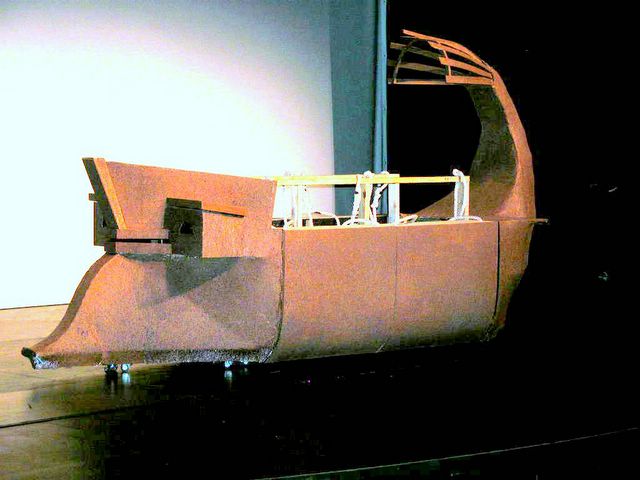
S. was in a production of The Odyssey last week, and this is the boat the kids built prior to the performance.
And here are Jack Aubrey's views towards Ulysses and those who wish to go off course to catch a glimpse of Ithaca, as told in a letter Stephen Maturin writes home to Diana in Treason's Harbour:
. . . 'To Ithaca itself, upon my word of honour. But would any amount of pleading on my part or on the part of all the literate members of the ship's company induce that animal to bear away for the sacred spot? It would not. Certainly he had heard of Homer, and had indeed looked into Mr Pope's version of his tale; but for aught he could make out, the fellow was no seaman. Admittedly Ulysses had no chronometer, and probably no extant neither; but with no more than log, lead and lookout an officer-like commander would have found his way home from Troy a d-d sight quicker than that. Hanging about in port and philandering, that was what it amounted to, the vice of navies from the time of Noah to that of Nelson. And as for that tale of all his foremast hands being turned into swine, so that he could not win his anchor or make sail, why, he might tell that to the Marines. Besides, he behaved like a very mere scrib to Queen Dido-though on second thought perhaps that was the other cove, the pious Anchises. But it was all one: they were six of one and half a dozen of the other, neither seamen nor gentlemen, and both of 'em God d-d bores into the bargain. For his part he far preferred what Mowett and Rowan wrote; that was poetry a man could get his teeth into, and it was sound seamanship too; in any case he was here to conduct his convoy into Santa Maura, not to gape at curiosities.'
Tuesday, July 26, 2005
Subscribe to:
Posts (Atom)
-
Last night I read Julian Barnes' The Sense of an Ending . Yes, the night before it went up against Donald Ray Pollock's The Devil Al...
-
As I said on New Year's Day, one of my projects for the year is to keep track of all the reading done by the characters in the fiction t...
-
 Anthony Trollope's 200th birthday takes place on April 24, and Karen at Books and Chocolate is hosting an Anthony Trollope Bicenntenni...
