By the time I finish this post, R.'s plane should have landed at LaGuardia and I can switch from worrying about plane crashes to worrying about whether things will go smoothly and safely for her in NY--that's how I intend to spend my New Year's Eve. S. and his buddy have been fed, have their sleeping bags and plentiful snacks for later in the evening, and L. and I will probably both go to bed early since we'll be getting up at 5:45 tomorrow to determine whether the new dvr will come on as programmed or whether it will need a manual nudge. A 12-hour marathon of clean, uncut episodes of Alias Smith and Jones, my all-time favorite show! It will be a very happy New Year, indeed.
Thirty-three years ago today Pete Duel, co-star of Alias Smith and Jones, committed suicide. I can remember how my eyes met those of my friend K. across the Monopoly board when the news came over the radio. She'd spent the night with me the night before so that we could watch the latest episode together. K. was the one who'd decided we couldn't love both Heyes and Curry, the way that I'd been inclined to do, the way that I'd loved Butch and Sundance, but that they had to be divided between us. Thirty-three years ago today, without batting an eye, she betrayed her former chosen one: "I like Kid Curry better."
I've been an unabashed Hannibal Heyes fan ever since.
There's a Guy Clark lyric that goes "Stuff that works/ stuff that holds up /The kind of stuff you don’t hang on the wall /Stuff that’s real, stuff you feel /The kind of stuff you reach for when you fall" and I've been thinking today about the stuff that's worked for me since childhood, the stuff I've never had to be embarrassed over liking, or outgrowing, or simply having its sheen of magic fade on me:
Farm sets and plastic dinosaurs. Green-feathered parrots. Harriet the Spy and Edie Cares. Alice, in both Wonderland and Through the Looking Glass. Old Yeller and Little Arliss and Jumper the Mule. Johnny Cash. Alias Smith and Jones. A horse that whinnies with pleasure at the sight of you. A walk in the woods. These have been the constants throughout my life, the childhood pleasures that have had lasting worth, the things that have belonged to me. I love them all dearly.
Sixteen years ago today I was in the hospital because my body had betrayed both me and the baby inside me. Sixteen years ago tomorrow a two pound six ounce baby would be cut from me eight weeks before he was due. Before a week was over he'd have pulled the tube from his nose and begun the task of breathing on his own. Sixteen years later he'll have matured into the type of young man who won't mind when his crazy momma wakes him and his buddy up at the crack of dawn on his birthday to record the show she was obsessed with when she was a kid.
He's even a Hannibal Heyes fan.
Friday, December 31, 2004


You come to this place, midlife. You don't know how you got here, but suddenly you're staring fifty in the face. When you turn and look back down the years, you glimpse the ghosts of other lives you might have led. All your houses are haunted by the person you might have been. The wraiths and phantoms creep under your carpets and between the warp and weft of your curtains, they lurk in wardrobes and lie flat under drawer liners. You think of the children you might have had but didn't. When the midwife says, "It's a boy," where does the girl go? When you think you're pregnant, and you're not, what happens to that child that has already formed in your mind? You keep it filed in a drawer of your consciousness, like a short story that wouldn't work after the opening lines.
--Hilary Mantel. Giving Up the Ghost
--Hilary Mantel. Giving Up the Ghost
Thursday, December 30, 2004
Snow crystals
"Think of yourself as a 4- or 5-year-old, hurtling through the pointillist magic of a snowstorm, your tongue out to catch as many falling flakes as you can, hearing that these countless bits of frozen fluff have secret lives, that they are all different, never repeated, despite the clear evidence before your eyes that they are identical and undistinguishable. Someone, perhaps your kindergarten teacher, may have opened a book of photographs of the unreplicated beauty hidden in every flurry." (Owen Edwards in Smithsonian)
Autodidact Wilson Bentley, the Vermont farmer who discovered that no two snowflakes are alike, devised a mechanism in the 1880s that combined a microscope with a view camera. He made photographs of thousands of snowflakes using light-sensitive plates, not for profit, but for the sheer joy of doing so. Efforts to give a manuscript and 20 years' worth of photographs to the Smithsonian in 1904 were rebuffed, leading Bentley to sell many of his glass plates to schools and colleges for a nickel apiece. He later wrote an article for National Geographic and collaborated on a book called Snow Crystals that contained 2,500 illustrations.
Autodidact Wilson Bentley, the Vermont farmer who discovered that no two snowflakes are alike, devised a mechanism in the 1880s that combined a microscope with a view camera. He made photographs of thousands of snowflakes using light-sensitive plates, not for profit, but for the sheer joy of doing so. Efforts to give a manuscript and 20 years' worth of photographs to the Smithsonian in 1904 were rebuffed, leading Bentley to sell many of his glass plates to schools and colleges for a nickel apiece. He later wrote an article for National Geographic and collaborated on a book called Snow Crystals that contained 2,500 illustrations.
Sontag quote
In our culture, TV--above all--dominates literacy. The authority of literature--if not the number of readers--has declined. But books need readers as well as publishers and writers. Literacy is a form of authority, it is not just a skill. There are desirable forms of literacy and empty forms. Writers, of course, are readers as well. When I taught creative writing I didn't produce writers, I was really teaching reading.
--Susan Sontag
--Susan Sontag
Wednesday, December 29, 2004
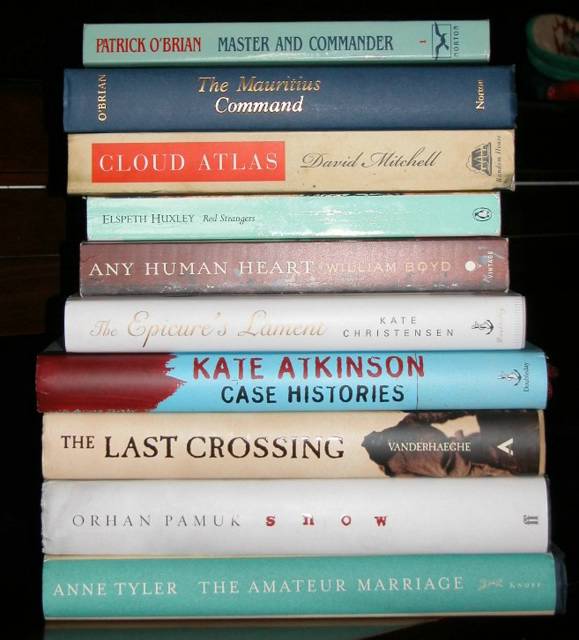
It was a good year for reading. Here's a meandering, uneven look at a stack of the best books I read this year (cobbled together from an earlier reading journal, when necessary):
Cloud Atlas was my hands down favorite. I haven’t been this excited over a book since discovering Orhan Pamuk’s My Name is Red in the spring of 2003. Both clever and brilliant, funny and heartbreaking, the book left me feeling exhilarated and full of hope—an amazing achievement considering that we’d been through the end of civilization and back again. A couple of the story lines, the contemporary ones, seemed of lighter heft when first introduced, and my attention flagged, but both managed to convince me of their import in their concluding sections.
There are numerous reviews of this one out there, and I particularly enjoy the Byatt and Norfolk (Complete Review), so I’ll not say more here except, oh, how I wish I’d written this book.
------
From its first paragraph:
“Muthengi was fourteen years old when he first saw a column of shining-skinned young Kikuyu warriors swinging along the forest’s edge toward the plains, like a ripple of wind across a field of ripening grain, on the way to war. Afterwards he could not remember the names of the warriors, nor the boasting words they had shouted to his father as they loped past, nor even the designs painted boldly in black and red on their long shields; but from that moment he became a warrior; his spirit marched with theirs, and dreams of battle filled his waking mind. While others of his age were preoccupied with their skill in games, with the herding of goats, or with bird-scaring among the millet, he would practice hurling sticks against the trunk of a banana tree; and in his imagination bronze-limbed Masai warriors surged in full retreat over the millet-fields, and captured Masai cattle flowed in a brown flood over the pastures of his clan.”
To its last:
“He was glad that God had decided to bless his wives with fertility, now that he had been baptized a Christian. The name of the child, he decided should be Aeroplane. His wife, he thought, would never be able to pronounce such a difficult word, but educated people would know, and understand.”
Elspeth Huxley describes the lives of four generations of a family in Kenya, both before and after European settlers—the Red Strangers of the title—move in and transform their way of life. Female circumcision rites are presented. Customs and beliefs and morality are encountered and come to seem more logical to the reader than those substituted by the Europeans.
R. selected this one in Borders three or four years back, although I don’t think she ever got around to reading it. It’s out of print now, but is definitely worth going through the trouble of getting through interlibrary loan.
I’d stuck this note in the back of Red Strangers:
“First we must study how colonization works to decivilize the colonizer, to brutalize him in the true sense of the word, to degrade him, to awaken him to buried instincts, to covetousness, violence, race hatred, and moral relatism.” –Aime Cesaire
-----
Anne Tyler has been my favorite writer for 25 years now, but she never made me cry until this January. The Amateur Marriage is definitely the best Tyler of recent years although it's no Dinner at the Homesick Restaurant or Searching for Caleb; although passing reference is made to Ezra's gizzard soup and the private investigator hired by the Pecks, I was happy to note. I didn't like it at first; I read the first three chapters the night my Amazon shipment arrived and was terribly disappointed by how ordinary the characters seemed. But everything clicked for me the next day, and it became a book that I literally didn't want to put down. I teared up several times and wound up crying for an hour after I'd finished it. Realized later that I must have been subconsciously comparing Michael and Pauline's relationship with my parents', and when it eventually veered off on a different course, well, I think my heart broke for four people instead of for two.
-----
William Boyd wears sly boots. Prior to publishing Any Human Heart, which includes cover art by and mention of New York artist Nat Tate, who destroyed most of his work before jumping off the Staten Island Ferry at age 31, he wrote a biography of Tate, in which he claims that he first learned of Nat Tate while editing the collected journals of Logan Mountstuart (the protagonist of Any Human Heart). Tate, of course, is as fictional as LMS himself, but Boyd managed to fool quite a few people who should have known better before it was all revealed as a hoax. I'm only disappointed in that Nat Turner: An American Artist is out of print, because I would enjoy looking for it in bookstores, where, same as with Steven Millhauser's Edwin Mullhouse, I would probably find it mistakenly shelved with the biographies.
I encountered—briefly-- two or three of the characters from Any Human Heart in Boyd’s The New Confessions later in the year and was happy to see them. Logan Mountstuart, through whose journals readers view both the 20th century and his evolution as a writer, managed to both infuriate me with his actions while making me care deeply about what happened to him.
-----
Not epic in scope like Any Human Heart, but also told through the journals of another infuriating antihero narrator, Kate Christensen’s The Epicure’s Lament was a joy from start to finish. I wound up loving the determinedly unlovable misanthropic Hugo Whittier, whose intentions to read and eat and smoke himself to death go wonderfully askew. I’ve read all Christensen’s novels, but this one is by far the best. I can’t wait to read it again.
-----
From my journal last February:
I ventured out in the early hours of last Thursday's snow storm to pick up Guy Vanderhaeghe's latest, The Last Crossing, at the public library based on a glowing endorsement from a Readervillan with impeccable taste and the fact it'd just been chosen winner of the Canada Reads program. The biggest snow storm of the past 16 years and a book I was most anxious to read--an unbeatable combination.Or so I thought. From Thursday to Saturday, I managed only 40 pages in The Last Crossing. It refused to snare my attention. I'd read Vanderhaeghe's The Englishman's Boy back in the fall of '01 and came away with a feeling of "eh," and that's all I was managing with this one. I much preferred watching Season 1 eps of Angel with S. On Sunday I picked it up again and it was good. Very good. By the time I finished it last night I'd decided The Last Crossing is, next to Lonesome Dove, the best western I've read. The ending is probably a little too good to be true, the identity of the murderer a little too underscored, and now that I've looked back on the first 40 pages I'm not sure exactly what my problem was there, except that the book refused to come alive for me until Custis Straw was introduced peeing on the haystack behind the livery and hauled off to jail, so maybe the book should have started there, and all the previous stuff worked in later, or left out altogether? Maybe I just shouldn't expect a book to grab me if I can't manage to give it more than five or ten minutes' worth of attention at a time.
At any rate, The Last Crossing is the story of Victorian brothers Addington and Charles Gaunt, who have been sent to Fort Benton by their domineering father to search for Charles' twin Simon. Simon had earlier gone to America with an insane minister who believes "Red Indians" are the Lost Tribes of Israel, and has not been heard from since. The brothers, evil former military captain Addington and not particularly talented artist Charles, hire a half-breed guide, Jerry Potts, and a sycophant reporter to write a book on Captain Gaunt's hunting adventures. They agree to take along Lucy Stoveall, who pretends to be looking for her brutal husband instead of the men she's sure recently raped and murdered her younger sister. Custis Straw, Civil War veteran and book's true center, takes off after Lucy, whom he loves, and his best friend, saloonkeeper Aloysius Dooley, takes off after Custis. Beautiful descriptive writing, characters with interior lives and individual voices, witty, lively dialogue. Finest kind of book.
-----
C. first introducted me to Kate Atkinson back in ’99 with Behind the Scenes at the Museum, and I’ve been a fan since. I had this to say about Not the End of the Story back in January: Totally enchanting mix of contemporary and/or apocalyptic short stories that twist into updated versions of classical myths, liberally sprinkled with references to Buffy the Vampire Slayer. Wonderful, wonderful, wonderful. Made me want to reread Human Croquet for another wallow in the catnip that is Kate.
Case Histories is even better than the story collection.
-----
I wonder how long it'll be before Orhan Pamuk wins the Nobel Prize? I started Snow before the Europe trip and was just blown away. I shouldn't have attempted to read it in Germany since it's a book that deserves more concentration than I could give it there, although I experienced a frisson reading about Ka living in the Turkish sector of Frankfort while we were staying at in an apartment in the Turkish sector of Berlin. I'll be a better reader of this one the next time and I'll read Dostoevsky's Demons before I do. Margaret Atwood wrote the best review I've seen of Snow. (New York Times)
-----
Aubrey/Maturin series by Patrick O'Brian. My favorite review comes from Forty-Two: "The past as epic fantasy – with bird watching. A 5,000-page buddy movie (but not the crap Hollywood version). Introvert and extrovert fall in love, go around the world (without violating Article XXIX). Best is #13 – tea with an orangutan atop a volcano."
I haven't reached the orangutan yet, but I love the debauched sloth.
-----
Not available for the photo op:
Anne Tyler was interviewed in the NY Times earlier this month. She said she reads contemporary fiction "nonstop," and that new writers seem "to be starting out at a higher and higher level." She said she was reading "fresh, funny, quirky" The Sleeping Father by Matthew Sharpe. The Sharpe was on the new book cart in the back when I went to work that evening, and since I'd finished the Boyd the day before, started it immediately. Astringent, darkly humorous, ultimately warmhearted, I doubt I would have trusted a book giving the postmodernist treatment to a family dealing with a parent's coma and stroke and subsequent rehab to do anything more than push all my buttons, but Sharpe made it work. I loved the relationship between Chris and his best buddy Frank Dial. (February)
-----
Evidence of Things Unseen by Marianne Wiggins. I don't know where Wiggins is from, but I doubt it's North Carolina: shortening the name "Foster" to "Fos" works well to underscore the character's interest in phosphorescent light, but it's generally pronounced "Fawster" around these here parts. Otherwise, I loved, loved, loved this book until the end, when the coincidences and Wiggins' desire to set up generational parallels got a little out of hand. I'd like to pick up a used copy of this sometime. (August)
-----
I luxuriated in Colm Toibin's The Master all of last week, and if it weren't for books I have to read now (because, you know, due dates trump current interest nine times out of ten in my world), I'd let that one chart my course for a good while to come. I should give The Golden Bowl another try. I have a leatherbound edition of James' short fiction that I'll work my way through first, though. And maybe Milly Theale won't make me want to pull my hair out if I read Wings of the Dove again now that I know about Minny Temple. But before I get around to any more Henry James, I want to read Constance Fenimore Woolson, Alice James' diary (I checked it out last week, and two days later someone came in and asked me to help her find it for her women's diary class, and I brought it back in to her), and R.W.B. Lewis' bio of the James family. At the moment I'm reading Oscar Wilde, whose theatrical success came as James' debut resoundingly failed. (September)

Tuesday, December 28, 2004
'Prodigious,' said Stephen. 'And yet in a way one might say that the whole of life is a tissue of prodigious coincidences: as for example that at the very moment we attempt to cross the road this particular coach and six should come by; yet though extremely unlikely, it is a fact. And the glabrous face within belongs to Monsieur de Talleyrand-Perigord.' Stephen took off his hat: the glabrous face returned his bow. 'It is a most improbable coincidence that as we enter La Mothe's courtyard, and it is just here, on the right--take care of the excrement, Villiers--some merchant should walk into his counting-house in Stockholm, or that Jack Aubrey should mount his horse to pursue the fox. Though now I come to think of it, Jack would scarcely pursue the innocent fox at this time of the year: yet the principle remains. You may object that the overwhelming majority of these coincidences are undetected, which is eminently true; but they are there for all that, and as I raise this knocker, some man in China breathes his last.'
And
'I am so sorry about the regulator: Charlotte's dormouse got into it, and is having babies."
And
Without the shadow of a doubt this was the Alca impennis of Linnaeus, the Great Auk of some vulgar authors, a bird Stephen had longed to see all his life, a bird grown so rare that none of his correspondents but Corvisart had ever seen a specimen; and Corvisart was somewhat given to lying. 'And have you indeed seen your penguin, sir?' he asked.
'God love you, many and many a time,' said the young man, laughing. 'There is an island up that away,'--nodding towards Newfoundland--'where they breed by wholesale, and my uncle the Blue-Nose used to go there when he was fishing the Grand Bank. I went with him once, and we knocked them on the head by the score. It would have made you laugh, to see them standing there like ninepins, to be bowled over. We cut them up for bait, and ate the eggs."
'Blue-nosed hell-hound,' said Stephen inwardly, 'Goth, Vandal, Hun.' Aloud, and with as much amenity as he could summon, he asked, 'Is there any likelihood of seeing one on this bank?'
--Patrick O'Brian, The Surgeon's Mate
And
'I am so sorry about the regulator: Charlotte's dormouse got into it, and is having babies."
And
Without the shadow of a doubt this was the Alca impennis of Linnaeus, the Great Auk of some vulgar authors, a bird Stephen had longed to see all his life, a bird grown so rare that none of his correspondents but Corvisart had ever seen a specimen; and Corvisart was somewhat given to lying. 'And have you indeed seen your penguin, sir?' he asked.
'God love you, many and many a time,' said the young man, laughing. 'There is an island up that away,'--nodding towards Newfoundland--'where they breed by wholesale, and my uncle the Blue-Nose used to go there when he was fishing the Grand Bank. I went with him once, and we knocked them on the head by the score. It would have made you laugh, to see them standing there like ninepins, to be bowled over. We cut them up for bait, and ate the eggs."
'Blue-nosed hell-hound,' said Stephen inwardly, 'Goth, Vandal, Hun.' Aloud, and with as much amenity as he could summon, he asked, 'Is there any likelihood of seeing one on this bank?'
--Patrick O'Brian, The Surgeon's Mate
An education of the heart
I bought a copy of Susan Sontag's In America last fall, and the bookmark in my quotes commonplace book opens onto her page, but I've never read a book by her. She died today of leukemia at age 71. (LA Times)
From the obit:
"An early and passionate opponent of the Vietnam War, Sontag was both admired and reviled for her political convictions. In a 1967 Partisan Review symposium, she wrote that 'America was founded on a genocide, on the unquestioned assumption of the right of white Europeans to exterminate a resident, technologically backward, colored population in order to take over the continent.'
"In her rage and gloom and growing despair, she concluded that 'the truth is that Mozart, Pascal, Boolean algebra, Shakespeare, parliamentary government, baroque churches, Newton, the emancipation of women, Kant, Marx, Balanchine ballets, et al., don’t redeem what this particular civilization has wrought upon the world. The white race is the cancer of human history; it is the white race and it alone — its ideologies and inventions — which eradicates autonomous civilizations wherever it spreads, which has upset the ecological balance of the planet, which now threatens the very existence of life itself.'
She more recently aroused some fury with her New Yorker article following the Sept. 11 attacks:
"Where is the acknowledgment that this was not a ‘cowardly’ attack on ‘civilization’ or ‘liberty’ or ‘humanity’ or ‘the free world’ but an attack on the world’s self-proclaimed superpower, undertaken as a consequence of specific American alliances and actions?" She added, "In the matter of courage (a morally neutral virtue): Whatever may be said of the perpetrators of Tuesday’s slaughter, they were not cowards."
Her views on the purpose of literature:
" 'A novel worth reading is an education of the heart. It enlarges your sense of human possibility, of what human nature is, of what happens in the world. It’s a creator of inwardness.' " She was the cartographer of her own literary explorations. Henry James once remarked, 'Nothing is my last word on anything.' For Sontag, as for James, there was always more to be said, more to be felt. "
From the obit:
"An early and passionate opponent of the Vietnam War, Sontag was both admired and reviled for her political convictions. In a 1967 Partisan Review symposium, she wrote that 'America was founded on a genocide, on the unquestioned assumption of the right of white Europeans to exterminate a resident, technologically backward, colored population in order to take over the continent.'
"In her rage and gloom and growing despair, she concluded that 'the truth is that Mozart, Pascal, Boolean algebra, Shakespeare, parliamentary government, baroque churches, Newton, the emancipation of women, Kant, Marx, Balanchine ballets, et al., don’t redeem what this particular civilization has wrought upon the world. The white race is the cancer of human history; it is the white race and it alone — its ideologies and inventions — which eradicates autonomous civilizations wherever it spreads, which has upset the ecological balance of the planet, which now threatens the very existence of life itself.'
She more recently aroused some fury with her New Yorker article following the Sept. 11 attacks:
"Where is the acknowledgment that this was not a ‘cowardly’ attack on ‘civilization’ or ‘liberty’ or ‘humanity’ or ‘the free world’ but an attack on the world’s self-proclaimed superpower, undertaken as a consequence of specific American alliances and actions?" She added, "In the matter of courage (a morally neutral virtue): Whatever may be said of the perpetrators of Tuesday’s slaughter, they were not cowards."
Her views on the purpose of literature:
" 'A novel worth reading is an education of the heart. It enlarges your sense of human possibility, of what human nature is, of what happens in the world. It’s a creator of inwardness.' " She was the cartographer of her own literary explorations. Henry James once remarked, 'Nothing is my last word on anything.' For Sontag, as for James, there was always more to be said, more to be felt. "
Subscribe to:
Posts (Atom)
-
Last night I read Julian Barnes' The Sense of an Ending . Yes, the night before it went up against Donald Ray Pollock's The Devil Al...
-
As I said on New Year's Day, one of my projects for the year is to keep track of all the reading done by the characters in the fiction t...
-
 Anthony Trollope's 200th birthday takes place on April 24, and Karen at Books and Chocolate is hosting an Anthony Trollope Bicenntenni...
