Thirteen classics I'd like to read in 2007:
1. Charterhouse of Parma. Stendhal
2. Germinal. Zola
3. Tristram Shandy. Sterne
4. A Sentimental Journey. Sterne
5. Buddenbrooks. Mann
6. The Woodlanders. Hardy
7. The Turn of the Screw. James
8. The Idiot. Dostoyevsky
9. Robinson Crusoe. Defoe
10. The Cherry Orchard. Chekhov
11. Paradise Lost. Milton
12. The Blithedale Romance. Hawthorne
13. The Metamorphoses. Ovid
Thursday, October 19, 2006


Wednesday, October 18, 2006
Talking Heads
TV's hand puppets don't ooze out one word
These days about Iraq's oil. That can be taken
For granted. Anyone tuned-in will have heard
Strong-arm democracy brings home the bacon.
Once we've inflicted freedom and secured
Men's good will, we'll sleep sound, dream right, then wake
To heaped-up platters. Nobody's been forbidden
To mention things that nobody dares think--
That's honor among thieves. Loot, once hidden,
Can still be leached off quicker than a wink.
Where's your cut of the stash gone? Check your eyelids:
Sly thieves and robber barons never blink.
Slick puppet masters have to keep count who's
Made a killing and who's been double-crossed
To bury that on the dark side of the news,
The brain's recycle bin. True recall might cost
Friends, income, or a life too good to lose.
Analysts sometimes ask how decent Germans,
Facing a sudden scarcity of Jews,
Maintained their ignorance of the Holocaust:
None mentions just how many we let squirm
And twist at rope's end for their predetermined,
Preemptive wars. But then, of course, they lost.
--W.D. Snodgrass, Not For Specialists: New and Selected Poems
These days about Iraq's oil. That can be taken
For granted. Anyone tuned-in will have heard
Strong-arm democracy brings home the bacon.
Once we've inflicted freedom and secured
Men's good will, we'll sleep sound, dream right, then wake
To heaped-up platters. Nobody's been forbidden
To mention things that nobody dares think--
That's honor among thieves. Loot, once hidden,
Can still be leached off quicker than a wink.
Where's your cut of the stash gone? Check your eyelids:
Sly thieves and robber barons never blink.
Slick puppet masters have to keep count who's
Made a killing and who's been double-crossed
To bury that on the dark side of the news,
The brain's recycle bin. True recall might cost
Friends, income, or a life too good to lose.
Analysts sometimes ask how decent Germans,
Facing a sudden scarcity of Jews,
Maintained their ignorance of the Holocaust:
None mentions just how many we let squirm
And twist at rope's end for their predetermined,
Preemptive wars. But then, of course, they lost.
--W.D. Snodgrass, Not For Specialists: New and Selected Poems
This week My Bookstore is showcasing several my kids have enjoyed. (I can tell the bookstore is going to be the depository of all my nervous energy for awhile.)
Tuesday, October 17, 2006
R.I.P. Challenge: Harriet Hume

I conceived of my Rebecca West project --to read all of her fiction, in order published-- not long after reading The Return of the Soldier, a slim, every-word-tells account of a battle-injured man who returns home without a memory of the last 15 years of his life. I became even more of a West fan after reading The Judge, a great big sprawl of a novel that H.G. Wells made sure West knew he hated.
He was enthusiastic over her third, Harriet Hume, which she called a fantasy, not a novel; but then, main character Arnold Condorex was modeled on ambitious men of Wells' type, and Harriet herself was an embodiment of his belief in "the essential 'secondariness' of women," according to the Glendinning bio.
After an afternoon of love-making, Harriet Hume discovers that she can read Condorex' mind. She is dismayed to learn that no matter how idyllic their love, it is much more important for Condorex, a man without family or financial connections, to rise to political power than to remain with her. She lets him go without a fuss.
Aggressive and lacking scruples, Condorex manages to exalt himself to a lordship in large part due to his invention of a ficticious country in the far east on which he speaks most elegantly and knowingly. He marries for money and connection. Periodically he will run into Harriet Hume, largely unchanged, and realize that an unnerving connection remains between them: she can still read his mind and unearth the nasty truths he's managed to keep hidden from himself.
Twenty years later, financially and politically destroyed, abandoned by his friends, Condorex sets off to kill Harriet, his opposite, and thus, to his crazed mind, the author of his ruin. Harriet has told him earlier that she will not allow him to kill her, that it is her one duty not to die, so when he shows up in her garden brandishing a pistol, she calls the police.
"Oh, God above," he muttered, squirming and looking from the face of one to another and seeing nothing but patches of white dimness between a helmet and a chin-strap. "Has my opposite not only done me all this spiritual mischief, but has raised up a material army against me also!"
From this point on I cannot speak definitively. I think readers are supposed to believe that Condorex killed himself back in his study before setting off to Harriet's house, and that Harriet herself was buried a few days earlier in her hometown ("I was obliged to go there to assist at a religious ceremony," replied Harriet, "since they informed me they could not well have it without me.") but I can't quite square that with the conversation Condorex has with his servants after leaving the study or with Harriet's need to call the police, even if they are ghosts. Or why she says she won't allow Condorex to kill her. At any rate, once Harriet gets her house clean and permits Condorex to come in, the policemen wish them "A Very Happy Eternity."
And honestly, I just don't care to attempt to make sense out of it. West deliberately writes in an affected, archaic style (one V. Woolf would call "foppish") which I didn't enjoy in the least and sometimes couldn't make heads or tails of--there were three or four times in a descriptive passage when I just had to admit defeat and move on; repeated readings were not going to reveal the sense in a sentence inexplicable to me.
And I winced every time Harriet opened her mouth: she mews, she bleats, she sobs and she trills and titters. Condorex thinks of her most condescendingly: the little slut, the little hussy, the little silly dish of curds and whey. Ugh.
Fortunately for my Rebecca West project, the book is regarded an an aberation: critics "have tended to pass over Harriet Hume rapidly, labelling it mannered and insubstantial." For the R.I.P. Challenge, it was perfect--discussions of ghosts and other imaginary beings, London described as being "the colour of a grave," dead people at the end, and of course the unsettling notion of having every thought you have being transmitted into the mind of a woman who will then know you better than you know yourself.
If you're an ambitious man like Wells or Arnold Condorex, it will help if the woman who knows you also knows her place. Titter, titter.
Monday, October 16, 2006
Saturday, October 14, 2006
I'm about 50 pages from the end of Harriet Hume and when I get there I'm going to call "Finished!" to the R.I.P. Challenge. Granted, that means I'll have to count The Island of Doctor Moreau from back in August in order to reach the five book quota (reviews pending), and I'll have two-thirds of The Italian still to go, the book most appropriate for the challenge, but I want to give myself plenty of time to read Indiana for the Slaves and to make a bit of progress in In the Shadow of Young Girls in Flower for Involuntary Memory and the library stack needs some attention before I begin The Red and the Black with Isabella's crowd the first of November. Ann Radcliffe I can read slowly.
This evening, though, I'm watching Céleste, a German film with English subtitles based on Monsieur Proust, Céleste Albaret's memoir about her years as a housekeeper for Proust while he was writing Remembrance of Things Past.
And I now have what I've always wanted:
My own book store.
This evening, though, I'm watching Céleste, a German film with English subtitles based on Monsieur Proust, Céleste Albaret's memoir about her years as a housekeeper for Proust while he was writing Remembrance of Things Past.
And I now have what I've always wanted:
My own book store.
Friday, October 13, 2006
Fine Art Friday: Julio de Diego
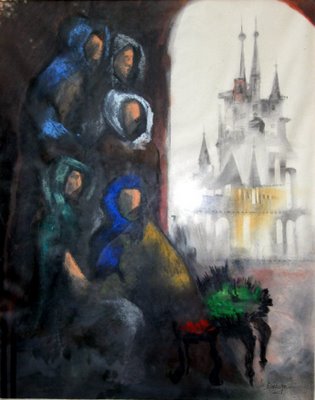
When I first saw, more than 25 years ago, the privately-owned watercolor shown above, all I was told about the artist was that he was Spanish and had once been married to Gypsy Rose Lee.
Thank goodness for the internet. Julio de Diego was quite an interesting character.
When Painter Julio de Diego was a boy of 15 in Madrid, he already knew that he wanted to be an artist, but his father, a wholesale and retail merchant, objected. Father insisted that Julio and Julio's brother should aim for business success. "He even removed the table from my bedroom to discourage me from drawing," recalls De Diego. "One day I found some of my drawings, and he had written all over them, destroying every one: 'You are a Bohemian and this will be the cause of your dying of hunger.' " So Julio stuffed a few clothes into a suitcase, left the house for good, and, true to the romantic pattern of art biographies, became a successful painter. His brother inherited the business, gambled it away, and killed himself. (Time Magazine)
By 1924 when de Diego landed in the United States as a political exile and grandly threw his remaining few cents into the wind from the top of the Woolworth Building, he had worked as a scenery designer, movie actor, ballet extra and army officer.
Starting from scratch, de Diego painted murals for kitchens and bathrooms, designed menus, provided fashion illustrations and children's book illustrations and magazine covers (scroll down slightly). He worked for the WPA, painting "street scenes, landscapes, and 'some very terrible murals.' " (Time Magazine)
His first major art show was in Chicago in 1932, and he retained a close relationship with the city throughout his career. His work is found in many museums.

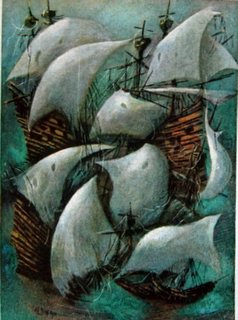
At age 62, de Diego exhibited 38 paintings at Manhattan's Landry Gallery devoted to the Spanish Armada:
Who but Julio would exhibit 38 paintings devoted exclusively to the Armada? Actually, there are many reasons why he became intrigued by the Armada, from the fact that it set sail on May 9, his birthday, to the fact that it is in every Spaniard's blood. Most of the paintings are small, but their scale does not detract from their impact. The ships struggle against wind and fire in a kind of wild dance; they glow bright red, founder among emerald waves, finally surrender to the sloshing rhythm of the sea. There is always high drama in the fall of a great fleet, and Julio de Diego has caught it well. The Armada's disaster has provided at least this welcome triumph. (Time)

Subscribe to:
Posts (Atom)
-
Last night I read Julian Barnes' The Sense of an Ending . Yes, the night before it went up against Donald Ray Pollock's The Devil Al...
-
As I said on New Year's Day, one of my projects for the year is to keep track of all the reading done by the characters in the fiction t...
-
 Anthony Trollope's 200th birthday takes place on April 24, and Karen at Books and Chocolate is hosting an Anthony Trollope Bicenntenni...
