Thursday, October 12, 2006
Pamuk wins
I wonder how long it'll be before Orhan Pamuk wins the Nobel Prize? I mused a couple of years ago. I don't have to wonder any longer.


Wednesday, October 11, 2006
Gass
The good books are the fruit of the tree of knowledge all right, and the devil is always offering us another fellow's damned opinion, which, were we to sample it, might cause the scales to fall from our eyes, so to see sudddenly that king and queen, God and all the angels, are naked, shivering, and in sore need of shoes. That is why just one good book, however greatly good, when used to bludgeon every other, turns evil; why we should be onmivorous: try kale, try squid, try rodent on a spit, try water even though there's wine, try fasting even, try--good heavens!--rice with beans. The good books are cookbooks and good readers read them, try them, stain their pages, adjust ingredients, pencil in evaluations, warn and recommend their recipes to friends.
~~
Yet, what is the goodness that makes the good books good? That confers this greatness on the great ones? Whence comes the character of "the classic" that gives it that cachet?
They glow because their authors are such fine, upstanding people from the best families, graduates of the most expensive schools, and representative of the nobler classes. When I was your age, we would have said to that suggest: in a pig's ear. Do you see a halo hanging over Heidegger's head? Their authors are murderers, thieves, traitors, mountebanks, misogynists, harlots, womanizers, idlers, recluses, sots, sadists, liars, snobs, lowlifes resentful of any success, vicious gossips, gamblers, addicts, ass-lickers, parvenues, whose pretenses to nobility were (and are) notorious: for instance, the clown whose father was a highland peasant named Balssa, lately come to town, and who renamed himself Balzac after an ancient noble family, and finally put a "de" before it, as if he were parking a Rolls in front of a tenement in the belief it might cause the johns to flush--a house, when Henry James paid a visit to Tours to take in the birthplace, he found to have been recently built but already a ruin, a row house that could at least have had the dignity, he said, to be "detached"--yes, a cheap pretender, this Balzac, who would go on to create a world more orderly than God's, almost as complete, and from beginning to end in better words, commencing with the fact that they were French. How about alleging that they glow because the good books uphold the finest ethical examples, support the highest values, display the most desirable attitudes? The way The Inferno is a testimonial to forgiveness? Or the Iliad a paean to pacifism? And by such edifying examples of revenge or the pleasure of killing an enemy, morally improving their readers, agenbiting their inwits, bestirring them to love their neighbors a bit better than themselves. Well, up a donkey's rear to that, too. One of the many lessons ours great teachers, the Nazis, taught us is that no occupation, no level of society, of wealth or education, no profession, no religious belief, no amount of talent, intelligence, or aesthetic refinement can protect you from fascism's virus, not to mention a dozen others. It is not a contradiction for the Chaucer scholar to beat his wife, especially if she resembles the Wife of Bath.
~~
The healthy mind goes everywhere, one day visiting Saint Francis, another accepting tea from Celine's bitter pot--ask for two sugars, please--and hiking many a hard mile through Immanuel Kant or the poetry of Paul Celan--a pair who will provide a better workout than the local gym--before taking a hard-earned vacation in the warm and luscious fictions of Colette. You will live longer and better by consuming deliciously chewy fats and reading Proust than by treadmilling to a Walkman tune and claiming to be educated because you peruse the Wall Street Journal and have recently skimmed something by Tom Wolfe.
--William H. Gass, A Temple of Texts
~~
Yet, what is the goodness that makes the good books good? That confers this greatness on the great ones? Whence comes the character of "the classic" that gives it that cachet?
They glow because their authors are such fine, upstanding people from the best families, graduates of the most expensive schools, and representative of the nobler classes. When I was your age, we would have said to that suggest: in a pig's ear. Do you see a halo hanging over Heidegger's head? Their authors are murderers, thieves, traitors, mountebanks, misogynists, harlots, womanizers, idlers, recluses, sots, sadists, liars, snobs, lowlifes resentful of any success, vicious gossips, gamblers, addicts, ass-lickers, parvenues, whose pretenses to nobility were (and are) notorious: for instance, the clown whose father was a highland peasant named Balssa, lately come to town, and who renamed himself Balzac after an ancient noble family, and finally put a "de" before it, as if he were parking a Rolls in front of a tenement in the belief it might cause the johns to flush--a house, when Henry James paid a visit to Tours to take in the birthplace, he found to have been recently built but already a ruin, a row house that could at least have had the dignity, he said, to be "detached"--yes, a cheap pretender, this Balzac, who would go on to create a world more orderly than God's, almost as complete, and from beginning to end in better words, commencing with the fact that they were French. How about alleging that they glow because the good books uphold the finest ethical examples, support the highest values, display the most desirable attitudes? The way The Inferno is a testimonial to forgiveness? Or the Iliad a paean to pacifism? And by such edifying examples of revenge or the pleasure of killing an enemy, morally improving their readers, agenbiting their inwits, bestirring them to love their neighbors a bit better than themselves. Well, up a donkey's rear to that, too. One of the many lessons ours great teachers, the Nazis, taught us is that no occupation, no level of society, of wealth or education, no profession, no religious belief, no amount of talent, intelligence, or aesthetic refinement can protect you from fascism's virus, not to mention a dozen others. It is not a contradiction for the Chaucer scholar to beat his wife, especially if she resembles the Wife of Bath.
~~
The healthy mind goes everywhere, one day visiting Saint Francis, another accepting tea from Celine's bitter pot--ask for two sugars, please--and hiking many a hard mile through Immanuel Kant or the poetry of Paul Celan--a pair who will provide a better workout than the local gym--before taking a hard-earned vacation in the warm and luscious fictions of Colette. You will live longer and better by consuming deliciously chewy fats and reading Proust than by treadmilling to a Walkman tune and claiming to be educated because you peruse the Wall Street Journal and have recently skimmed something by Tom Wolfe.
--William H. Gass, A Temple of Texts
A Thursday Thirteen
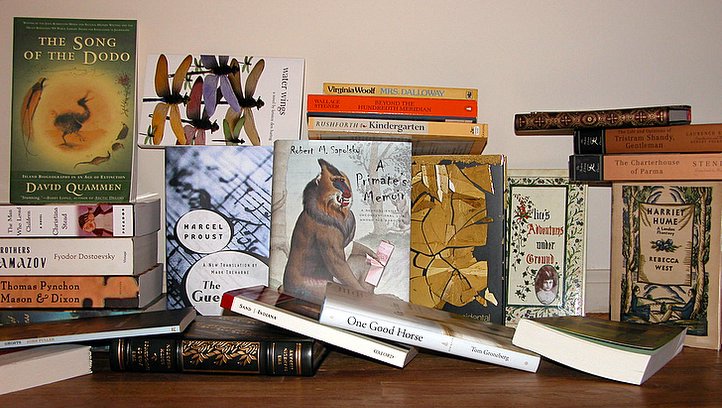
Thirteen random things about me. . .
1. I was in two separate bookstores last weekend and I didn't buy anything for myself either time. I did buy books for a baby shower, however.
2. The books I took with me to Utah:
Special Topics in Calamity Physics
Warlock
Indiana
3. My eyes are free agents and don't work in conjunction with one another. I find this a highly efficient system since I'm near-sighted in one and far-sighted in the other, but I evidently don't have as much depth perception as it takes to do those Magic Eye puzzles that get published with the Sunday comics.
4. When I was in high school I wore one contact lens.
5. I was taught to play clarinet in elementary school by a former Our Gang star. (Greenbriar wrote recently of Priscilla Calls' steadfast determination not to talk about it with her students.) Most of my friends in high school were in band and we were total snobs about it.
6. Part of me was relieved when my daughter, a trumpet player, decided not to be in high school band. The band at her school did not use the glide step and it would have been painful for me to be subjected to any other marching style (I did not tell her this at the time).
6. I was editor of the high school newspaper for two years. This gave me license to skip class--a lot--to go to the newspaper office in town where I worked as a stringer.
7. The first money I ever had I spent on two Johnny Cash albums.
8. The first book I ever read on my own was Green Eggs and Ham.
9. I don't have any wisdom teeth.
10. I met my husband in a bar in my hometown the summer after my freshman year at college. Among other things, I liked the fact that he wasn't from my hometown. But. . . it turned out that my mother's best friend/our next door neighbor had dated L.'s father in high school (last girlfriend before he met L.'s mother in college) and the publishers at the newspaper where I worked had played football with his dad in high school. I almost didn't go out with him because of the chorus of people telling me I should!
11. My son was Oberon in a fifth grade production of Midsummer's Night Dream. He was adorable.
12. For several years I had the idea that Dwight Yoakam was a Ray Stevens/Jerry Crowder type--more comedian than singer. In my defense, I was terribly sleep-deprived after R. was born (the year Dwight's first single hit the radio), I listened to the radio only in the car, and the announcers always did say his name as if there was a joke involved. I didn't become an obsessed fan until well after his fourth album was out, when I stumbled upon a Just Lookin' For a Hit tape in Brendles and realized the error of my ways.
13. I quit listening to country radio a good decade ago. My favorite radio station is WNCW, out of Isothermal Community College in Spindale.
In the ideal logotopia, every person would possess their own library, and add at least weekly, if not daily, to it. The walls of each home would seem made of books--wherever one looked, one would see only spines; because every real book (as opposed to dictionaries, almanacs, and other compilations) is a mind, an imagination, a consciousness. Together, they comprise a civilization, or even several. However, utopias have the bad habit of hiding in their hearts those schemes for success, those requirements of power, rules concerning conduct, which someone will one day have to carry forward, employ, and enforce in order to achieve them, and, afterward, to maintain the continued purity of their Being. Books have taught me what true dominion, what right rule is: It is like the freely given assent and labor of the reader who will dream the dreams of the deserving page and expect no more fee than the reward of its words.
--William H. Gass, A Temple of Texts
--William H. Gass, A Temple of Texts
One Coke for the Road
When I finished Kevin Brockmeier's A Brief History of the Dead last spring I immediately did a search to see if the Coca-Cola Corp. had sued--Coke is the instrument used to bring about a deadly virus.
Cormac McCarthy treats the ubiquitous liquid differently in The Road:
On the outskirts of the city they came to a supermarket. A few old cars in the trashstrewn parking lot. They left the cart in the lot and walked the littered aisles. In the produce section in the bottom of the bins they found a few ancient runner beans and what looked to have once been apricots, long dried to wrinkled effigies of themselves. They boy followed behind. They pushed out through the rear door. In the alleyway behind the store a few shopping carts all badly rusted. They went back through the store again looking for another cart but there were none. By the door were two softdrink machines that had been tilted over into the floor and opened with a prybar. Coins everywhere in the ash. He sat and ran his hand around in the works of the gutted machines and in the second one it closed over a cold metal cylinder. He withdrew his hand slowly and sat looking at a Coca Cola.
What is it, Papa?
It's a treat. For you.
What is it?
Here. Sit down.
He slipped the boy's knapsack straps loose and set the pack on the floor behind him and he put his thumbnail under the aluminum clip on the top of the can and opened it. He leaned his nose to the slight fizz coming from the can and then handed it to the boy. Go ahead, he said.
They boy took the can. It's bubbly, he said.
Go ahead.
He looked at his father and then tilted the can and drank. He sat there thinking about it. It's really good, he said.
Yes. It is.
You have some, Papa.
I want you to drink it.
You have some.
He took the can and sipped it and handed it back. You drink it, he said. Let's just sit here.
It's because I wont ever get to drink another one, isnt it?
Ever's a long time.
Okay, the boy said.
~~~
A review of The Road here.
Cormac McCarthy treats the ubiquitous liquid differently in The Road:
On the outskirts of the city they came to a supermarket. A few old cars in the trashstrewn parking lot. They left the cart in the lot and walked the littered aisles. In the produce section in the bottom of the bins they found a few ancient runner beans and what looked to have once been apricots, long dried to wrinkled effigies of themselves. They boy followed behind. They pushed out through the rear door. In the alleyway behind the store a few shopping carts all badly rusted. They went back through the store again looking for another cart but there were none. By the door were two softdrink machines that had been tilted over into the floor and opened with a prybar. Coins everywhere in the ash. He sat and ran his hand around in the works of the gutted machines and in the second one it closed over a cold metal cylinder. He withdrew his hand slowly and sat looking at a Coca Cola.
What is it, Papa?
It's a treat. For you.
What is it?
Here. Sit down.
He slipped the boy's knapsack straps loose and set the pack on the floor behind him and he put his thumbnail under the aluminum clip on the top of the can and opened it. He leaned his nose to the slight fizz coming from the can and then handed it to the boy. Go ahead, he said.
They boy took the can. It's bubbly, he said.
Go ahead.
He looked at his father and then tilted the can and drank. He sat there thinking about it. It's really good, he said.
Yes. It is.
You have some, Papa.
I want you to drink it.
You have some.
He took the can and sipped it and handed it back. You drink it, he said. Let's just sit here.
It's because I wont ever get to drink another one, isnt it?
Ever's a long time.
Okay, the boy said.
~~~
A review of The Road here.
Monday, October 02, 2006

Yay, Ella is back at the Box!
And I'm off to Utah. Or I will be after I pack my suitcase (two loads of laundry yet to go), and once I get off the computer (I haven't printed off my ticket yet). Same outfitters, same companions, same horse, I hope, but a different locale--this time Boulder Mountain with a drive through Zion.
I should be back the middle of next week, limping and sore, but posting should continue in my absence if the guys remember to do so.
Wishing everyone a wonderful week,
Susan
Sunday, October 01, 2006
Too. many. books. Too many in progress, too many wanting to go on vacation with me, too many that will be left behind. Too many arriving in packages, too many with my name on them on the library holds shelf. Too many unceremoniously being returned to the library unread, too many being renewed although rationally I know I won't get around to them until some time in, oh, say, 2008. Too many languishing pathetically on the book shelves and end tables and *cough, cough* sofa itself begging for a brief moment's attention while I attend to nonreading matters (yes, on occasion I do things other than read). Too many to finish by the end of the month for the R.I.P. Challenge and the Slaves of Golconda discussion to afford any deviation from October's list; reading at whim this month is strictly prohibited.
Even the publishing industry is wondering if there are too many good books this fall. (Scroll down for the Mental Multivitamin mention.)
And what has happened to the public library? I could always rely on them to process the new books I wanted a month or more after their publication date. I used this slowless to rationalize many a new book purchase. This fall the library is processing as fast as they're being published--Mark Haddon' s last month and Cormac McCarthy's last week. I'm tempted to inactivate my hold on The Echo Maker for a couple of weeks since I cannot possibly squeeze it in before November, but chances are I'll be able to renew it. If a local review sends library patrons scurrying after it I'll need to endure the university library's lollygagging around until Thanksgiving or later before I can read it.
Stefanie sent me a copy of The Looking Glass Wars this week, complete with accompanying cd. My pre-ordered in August copy of One Good Turn arrived Friday evening and Moral Disorder, slated to be a birthday present from my mother-in-law later in the month--along with yet another book that will be delivered by the end of the week--arrived on Saturday. They all look wonderful, but there are already too many books in progress and they will have to wait their turn.
I cannot possibly read fast enough.
Even the publishing industry is wondering if there are too many good books this fall. (Scroll down for the Mental Multivitamin mention.)
And what has happened to the public library? I could always rely on them to process the new books I wanted a month or more after their publication date. I used this slowless to rationalize many a new book purchase. This fall the library is processing as fast as they're being published--Mark Haddon' s last month and Cormac McCarthy's last week. I'm tempted to inactivate my hold on The Echo Maker for a couple of weeks since I cannot possibly squeeze it in before November, but chances are I'll be able to renew it. If a local review sends library patrons scurrying after it I'll need to endure the university library's lollygagging around until Thanksgiving or later before I can read it.
Stefanie sent me a copy of The Looking Glass Wars this week, complete with accompanying cd. My pre-ordered in August copy of One Good Turn arrived Friday evening and Moral Disorder, slated to be a birthday present from my mother-in-law later in the month--along with yet another book that will be delivered by the end of the week--arrived on Saturday. They all look wonderful, but there are already too many books in progress and they will have to wait their turn.
I cannot possibly read fast enough.
Subscribe to:
Posts (Atom)
-
Last night I read Julian Barnes' The Sense of an Ending . Yes, the night before it went up against Donald Ray Pollock's The Devil Al...
-
As I said on New Year's Day, one of my projects for the year is to keep track of all the reading done by the characters in the fiction t...
-
 Anthony Trollope's 200th birthday takes place on April 24, and Karen at Books and Chocolate is hosting an Anthony Trollope Bicenntenni...
