Friday, December 16, 2005


Thursday, December 15, 2005
Inductive? Deductive?
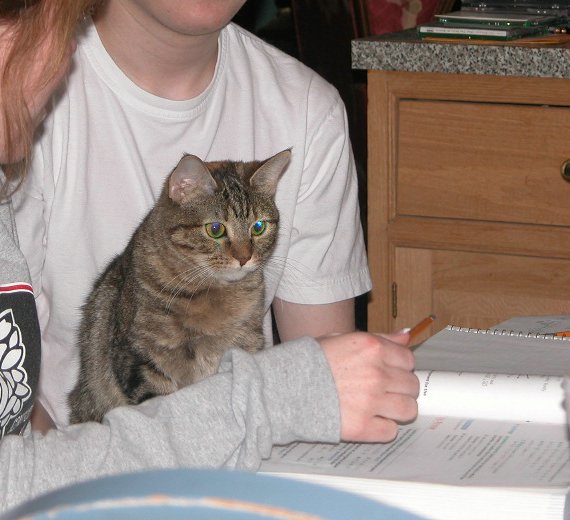
Ellie ponders why any kitten should be expected to learn how to think logically.
Pets are loading up on The Ark; Carnival of the Cats will be at Music and Cats Sunday evening.
I Want to Buy a Vowel (revisited)
Otherwise well-read John confessed in comments that he'd never heard of local boy John Welter, so here's a review I'd published in Creative Loafing several years back about his third novel---
John Welter, the Carrboro former shoe salesman
whose earlier scathingly funny satires have lambasted the
press and the secret service, turns the spotlight on both
religious fundamentalists and U.S. immigration policy in his
latest, I Want To Buy a Vowel. As in the earlier novels,
hilarity, insanity and canned luncheon meats run amok.
Alfredo Santayana, a 17-year-old Guatemalan, finds
himself in Waxahachie, Texas, with a green card chipping
paint to reveal the words "Western Auto" underneath and a
smattering of English phrases that he doesn't understand but
learned from watching TV: Beam me up, Scotty; Have you
driven a Ford lately; I'm not going to pay a lot for this
muffler. He's working in a Chinese restaurant, camping out
in a deserted house believed by the area children to be
haunted. He's also dreaming of buying a vowel, which "The
Wheel of Fortune" has assured him is one of the most
precious things on earth.
If life isn't hard enough already on Alfredo, enter
Kenlow Schindler, minister's son, "just an ordinary boy who
couldn't play football or do anything that might make him
seem valuable or desirable to anyone at all." Kenlow intends
to become "a recreational satanist," one who employs
"affordable" rituals that don't "require actually killing
anything or becoming friends with Satan."
Kenlow couples Vienna sausages, pork brains and
chicken giblets with pentagrams drawn in the dirt and the
town, media and fundamentalists go nuts. Nevermind that
there's no mutilated lifestock, no true evidence of any
sinister crime in the town, nevermind that sarcastic police
chief James McLemore tells a reporter that "based on all the
geometric evidence so far accumulated, it wasn't Satan they
should be looking for. It was Euclid." Once little girls Eva
and Ava Galt unearth a human bone during their dinosaur dig
near Alfredo's hiding place (later identified as that of a
possible 1929 cult victim), it's only a matter of time
before Alfredo is jailed, subjected to a whole-jail
exorcism, and threatened with deportation if a job too
demeaning for any real American to want cannot be found for
him.
To further complicate matters, Kenlow's father,
whose sermon notes include "Why Satan might make his
presence known through pork brains" and "Satan and the
apocalypse, as manifested in giblets," must contend with
"pornographic" scenes from the Bible being painted on the
ceiling of the local grocery. Chief McLemore is sidelined by
the FBI when a stamp machine with a believed likeness of the
Virgin Mary is stolen from the post office. Eva's parents
are only going through the motions of their marriage and Eva
prays to Ted Williams rather than God (this daughter of an
Episcopalian priest can't pray to a faceless entity) to make
them happy once again, all the while trying desperately to
help Alfredo and stand up to Kenlow's threats of brown-
bagged gall bladders and unsigned letters.
For me, the book's most poignant, serious-in-
intent moment comes when Eva's father tries to explain to
his daughter that no matter how much anyone knows about
religion, no one can say for sure why God leaves it up to
people to try to solve the problems of the world. His
explanation becomes an outloud musing into how the Bible was
put together: ". . . we have four Gospels. Sometimes it
makes me think that when the Bible was being written, there
was a short story contest, and the top four entries were
chosen for the collection. Actually, there were several
other gospels, but I think the editors sent out rejection
letters saying 'We already have four gospels. That's
enough.'"
Welter's third person narration, a departure from
the first person used in his earlier novels, capably juggles
its many characters, plot threads and funny lines. While
Eva is shown to be depressed and frightened at times, she
never comes across as a whine as did Welter's first person
narrators in Begin to Exit Here and Night of the Avenging
Blowfish. Unfortunately, the skipping about from character to
character keeps all but Eva from becoming unforgettable
people; the reader only knows enough to regard them as
deserving of ridicule or pity, rather than experiencing them
as fully rounded.
That's a minor complaint in a satirical work,
though. Welter addresses religious freedom, the treatment of
illegal aliens and sheer lunacy in a guaranteed laugh-out-
loud style. If social issues can be regarded as his
characters, Welter has exposed them in all their multi-sided
vulnerability.
John Welter, the Carrboro former shoe salesman
whose earlier scathingly funny satires have lambasted the
press and the secret service, turns the spotlight on both
religious fundamentalists and U.S. immigration policy in his
latest, I Want To Buy a Vowel. As in the earlier novels,
hilarity, insanity and canned luncheon meats run amok.
Alfredo Santayana, a 17-year-old Guatemalan, finds
himself in Waxahachie, Texas, with a green card chipping
paint to reveal the words "Western Auto" underneath and a
smattering of English phrases that he doesn't understand but
learned from watching TV: Beam me up, Scotty; Have you
driven a Ford lately; I'm not going to pay a lot for this
muffler. He's working in a Chinese restaurant, camping out
in a deserted house believed by the area children to be
haunted. He's also dreaming of buying a vowel, which "The
Wheel of Fortune" has assured him is one of the most
precious things on earth.
If life isn't hard enough already on Alfredo, enter
Kenlow Schindler, minister's son, "just an ordinary boy who
couldn't play football or do anything that might make him
seem valuable or desirable to anyone at all." Kenlow intends
to become "a recreational satanist," one who employs
"affordable" rituals that don't "require actually killing
anything or becoming friends with Satan."
Kenlow couples Vienna sausages, pork brains and
chicken giblets with pentagrams drawn in the dirt and the
town, media and fundamentalists go nuts. Nevermind that
there's no mutilated lifestock, no true evidence of any
sinister crime in the town, nevermind that sarcastic police
chief James McLemore tells a reporter that "based on all the
geometric evidence so far accumulated, it wasn't Satan they
should be looking for. It was Euclid." Once little girls Eva
and Ava Galt unearth a human bone during their dinosaur dig
near Alfredo's hiding place (later identified as that of a
possible 1929 cult victim), it's only a matter of time
before Alfredo is jailed, subjected to a whole-jail
exorcism, and threatened with deportation if a job too
demeaning for any real American to want cannot be found for
him.
To further complicate matters, Kenlow's father,
whose sermon notes include "Why Satan might make his
presence known through pork brains" and "Satan and the
apocalypse, as manifested in giblets," must contend with
"pornographic" scenes from the Bible being painted on the
ceiling of the local grocery. Chief McLemore is sidelined by
the FBI when a stamp machine with a believed likeness of the
Virgin Mary is stolen from the post office. Eva's parents
are only going through the motions of their marriage and Eva
prays to Ted Williams rather than God (this daughter of an
Episcopalian priest can't pray to a faceless entity) to make
them happy once again, all the while trying desperately to
help Alfredo and stand up to Kenlow's threats of brown-
bagged gall bladders and unsigned letters.
For me, the book's most poignant, serious-in-
intent moment comes when Eva's father tries to explain to
his daughter that no matter how much anyone knows about
religion, no one can say for sure why God leaves it up to
people to try to solve the problems of the world. His
explanation becomes an outloud musing into how the Bible was
put together: ". . . we have four Gospels. Sometimes it
makes me think that when the Bible was being written, there
was a short story contest, and the top four entries were
chosen for the collection. Actually, there were several
other gospels, but I think the editors sent out rejection
letters saying 'We already have four gospels. That's
enough.'"
Welter's third person narration, a departure from
the first person used in his earlier novels, capably juggles
its many characters, plot threads and funny lines. While
Eva is shown to be depressed and frightened at times, she
never comes across as a whine as did Welter's first person
narrators in Begin to Exit Here and Night of the Avenging
Blowfish. Unfortunately, the skipping about from character to
character keeps all but Eva from becoming unforgettable
people; the reader only knows enough to regard them as
deserving of ridicule or pity, rather than experiencing them
as fully rounded.
That's a minor complaint in a satirical work,
though. Welter addresses religious freedom, the treatment of
illegal aliens and sheer lunacy in a guaranteed laugh-out-
loud style. If social issues can be regarded as his
characters, Welter has exposed them in all their multi-sided
vulnerability.
Links on an icy morning
"Maybe we shouldn't be talking about literature at all," I say.
"Ha, ha," he says. "Now you're talking! I would be wonderful with a 100-year moratorium on literature talk, if you shut down all literature departments, close the book reviews, ban the critics. The readers should be alone with the books, and if anyone dared to say anything about them, they would be shot or imprisoned right on the spot. Yes, shot. A 100-year moratorium on insufferable literary talk. You should let people fight with the books on their own and rediscover what they are and what they are not. Anything other than this talk. Fairytale talk. As soon as you generalise, you are in a completely different universe than that of literature, and there's no bridge between the two."
Martin Krasnik's interview with Philip Roth
Most of you, if not all of you, like me, feel inadequately educated. That is an ordinary feeling for a member of our species. One of the most brilliant human beings of all times, George Bernard Shaw said on his 75th birthday or so that at last he knew enough to become a mediocre office boy. He died in 1950, by the way, when I was 28. He is the one who said, “Youth is wasted on the young.” I turned 83 a couple weeks ago, and I must say I agree.
Shaw, if he were alive today, would envy us the solid information that we have or can get about the nature of the universe, about time and space and matter, about our own bodies and brains, about the resources and vulnerabilities of our planet, about how all sorts of human beings actually talk and feel and live.
Kurt Vonnegut's "Your Guess is as Good as Mine"
"Ha, ha," he says. "Now you're talking! I would be wonderful with a 100-year moratorium on literature talk, if you shut down all literature departments, close the book reviews, ban the critics. The readers should be alone with the books, and if anyone dared to say anything about them, they would be shot or imprisoned right on the spot. Yes, shot. A 100-year moratorium on insufferable literary talk. You should let people fight with the books on their own and rediscover what they are and what they are not. Anything other than this talk. Fairytale talk. As soon as you generalise, you are in a completely different universe than that of literature, and there's no bridge between the two."
Martin Krasnik's interview with Philip Roth
Most of you, if not all of you, like me, feel inadequately educated. That is an ordinary feeling for a member of our species. One of the most brilliant human beings of all times, George Bernard Shaw said on his 75th birthday or so that at last he knew enough to become a mediocre office boy. He died in 1950, by the way, when I was 28. He is the one who said, “Youth is wasted on the young.” I turned 83 a couple weeks ago, and I must say I agree.
Shaw, if he were alive today, would envy us the solid information that we have or can get about the nature of the universe, about time and space and matter, about our own bodies and brains, about the resources and vulnerabilities of our planet, about how all sorts of human beings actually talk and feel and live.
Kurt Vonnegut's "Your Guess is as Good as Mine"
Wednesday, December 14, 2005
A useful pot for putting things in. . .
or, I try to exhibit the proper ho ho ho
I dunno, it's just hard this year. I thought maybe by answering some of the questions and concerns that have brought strangers to the blog the last few days that I could get a bit more into the proper frame of mind for this time of year.
How many pages are in the book Sugar Snow, the short one
32.
What is the purpose of the letters written in the last crossing by guy vanderhaeghe?
Communication. Remember, this is before the days of cell phones and text messaging.
What was the thesis of Love and Hate in Jamestown.
Life is tough and then you die.
Why gym is stupid.
Nancy Grace. Under no circumstances should you go to the gym and attempt to walk on the treadmill while Nancy Grace is on the verge of spontaneous combustion over some local crime story that she's elevating to a national crisis. If your audio player is malfunctioning and all you have to distract yourself from Her Awfulness is the last page of The Year of Magical Thinking when you're a good half-book away from the last page anyway expect to have a horrible time. As long as you can manage to avoid going to the gym while Nancy Grace is on the television seeking vengeance gym won't be near as stupid as you thought it'd be.
hannibal heyes kid curry gay
Jack Twist and Ennis Del Mar from Annie Proulx's "Brokeback Mountain" are gay, but Heyes and Curry are not.
The determination of a subset of fans to put a homosexual spin on Heyes and Curry's friendship always reminds me of the time I worked for a company that scored student writing proficiency tests. One of the other team leaders had a woman on her team who told her the first day that because she was a minister's wife she would be unable to score any tests that were written by gay students. No one thought this would be an issue; no one could even remember having previously seen a paper indicating that a student was gay. But several times a day the woman would bring back a paper to her team leader that she just knew was written by a homosexual and the rest of us would pass around a totally generic standard-issue essay on how the school cafeteria would be much improved if the workers wore hair nets or if they could have pizza brought in by an outside vendor and wonder what in the world she'd read into the essay to trip her gay wire.
Munro runaway goat
Forget the little—if any—that you know about scapegoats or sacrificial goats. Ignore any info you might have on Judas goats while you're at it. Concentrate on the fact that not only is the story entitled "Runaway" but so's the entire collection! Clearly this is significant. Skip ahead to "Soon," the third story in the collection. Read the description of the white heifer. Isn't it obvious? The goat's run away and is now serving as a model for Chagall! Sometimes Chagall paints the goat as a goat but sometimes he transforms him into other creatures. The goat doesn't mind what he's immortalized as—he's just relieved to be out of that first story which he found a tad dangerous.
important passages Don Quixote
You'll impress your teacher with your thorough knowledge of the book by quoting this final passage:
However, as it is rare to cure insanity, people say that when he left the Court he went back to his mania, bought another and better horse, and returned to Old Castile. Stupendous and unheard-of-adventures happened to him there, for he took as his squire a "working girl" he found by the Tower of Lodones. She was dressed like a man and was fleeing from her master because in his house she became, or they made her become pregnant unwittingly, although not because she didn't give plenty of cause for it. She was roaming around in fear, and the good knight took her without knowing she was a woman until she gave birth in the middle of the road and in his presence, leaving him highly astonished at the birth and imagining the wildest fancies about it.
Nah. I'm still too cranky for Christmas.
I dunno, it's just hard this year. I thought maybe by answering some of the questions and concerns that have brought strangers to the blog the last few days that I could get a bit more into the proper frame of mind for this time of year.
How many pages are in the book Sugar Snow, the short one
32.
What is the purpose of the letters written in the last crossing by guy vanderhaeghe?
Communication. Remember, this is before the days of cell phones and text messaging.
What was the thesis of Love and Hate in Jamestown.
Life is tough and then you die.
Why gym is stupid.
Nancy Grace. Under no circumstances should you go to the gym and attempt to walk on the treadmill while Nancy Grace is on the verge of spontaneous combustion over some local crime story that she's elevating to a national crisis. If your audio player is malfunctioning and all you have to distract yourself from Her Awfulness is the last page of The Year of Magical Thinking when you're a good half-book away from the last page anyway expect to have a horrible time. As long as you can manage to avoid going to the gym while Nancy Grace is on the television seeking vengeance gym won't be near as stupid as you thought it'd be.
hannibal heyes kid curry gay
Jack Twist and Ennis Del Mar from Annie Proulx's "Brokeback Mountain" are gay, but Heyes and Curry are not.
The determination of a subset of fans to put a homosexual spin on Heyes and Curry's friendship always reminds me of the time I worked for a company that scored student writing proficiency tests. One of the other team leaders had a woman on her team who told her the first day that because she was a minister's wife she would be unable to score any tests that were written by gay students. No one thought this would be an issue; no one could even remember having previously seen a paper indicating that a student was gay. But several times a day the woman would bring back a paper to her team leader that she just knew was written by a homosexual and the rest of us would pass around a totally generic standard-issue essay on how the school cafeteria would be much improved if the workers wore hair nets or if they could have pizza brought in by an outside vendor and wonder what in the world she'd read into the essay to trip her gay wire.
Munro runaway goat
Forget the little—if any—that you know about scapegoats or sacrificial goats. Ignore any info you might have on Judas goats while you're at it. Concentrate on the fact that not only is the story entitled "Runaway" but so's the entire collection! Clearly this is significant. Skip ahead to "Soon," the third story in the collection. Read the description of the white heifer. Isn't it obvious? The goat's run away and is now serving as a model for Chagall! Sometimes Chagall paints the goat as a goat but sometimes he transforms him into other creatures. The goat doesn't mind what he's immortalized as—he's just relieved to be out of that first story which he found a tad dangerous.
important passages Don Quixote
You'll impress your teacher with your thorough knowledge of the book by quoting this final passage:
However, as it is rare to cure insanity, people say that when he left the Court he went back to his mania, bought another and better horse, and returned to Old Castile. Stupendous and unheard-of-adventures happened to him there, for he took as his squire a "working girl" he found by the Tower of Lodones. She was dressed like a man and was fleeing from her master because in his house she became, or they made her become pregnant unwittingly, although not because she didn't give plenty of cause for it. She was roaming around in fear, and the good knight took her without knowing she was a woman until she gave birth in the middle of the road and in his presence, leaving him highly astonished at the birth and imagining the wildest fancies about it.
Nah. I'm still too cranky for Christmas.
Monday, December 12, 2005
Booked by Three
I'm participating in Shelley's December Booked by Three poll:
1. Books/Magazines as gifts.
Do you give them?
Have I ever not given them to my kids? S. exclaimed after learning the truth about the Easter bunny and the tooth fairy: "Oh, so that's why they always brought me books!"
Other than the kids, I usually only give books regularly to my mother-in-law, who appreciates them. And I used to give Larry McMurtrys to my dad, who only bought paperback westerns for himself. I try to give the nieces and nephews something they've specifically requested; they know if they don't speak up they'll probably get books.
Do you get them?
From the kids, yes, and usually my mother-in-law gives me a gift certificate to use for buying books. This year, though, I'm getting Something Else.
If you've gotten any as gifts, do you have a favorite?
Probably Black Beauty back in second grade.
2. End of Year Stats
Most books read in a year?
I read 112 in 2000. I probably read many more than that in a year when I was a child, but unless I can unearth my old diaries from my parents' basement I can't prove it.
Least number of books read in a year?
I made it through eight in 1986. My daughter did not permit me to read while she nursed. I watched a lot of Sesame Street that year.
Average number of books read in a year?
Since '93 I've ranged between 44 and 112 books, with an average of 80.
3. Any reading material on your wish list this year?
I know exactly what I'm getting. . .
1. Books/Magazines as gifts.
Do you give them?
Have I ever not given them to my kids? S. exclaimed after learning the truth about the Easter bunny and the tooth fairy: "Oh, so that's why they always brought me books!"
Other than the kids, I usually only give books regularly to my mother-in-law, who appreciates them. And I used to give Larry McMurtrys to my dad, who only bought paperback westerns for himself. I try to give the nieces and nephews something they've specifically requested; they know if they don't speak up they'll probably get books.
Do you get them?
From the kids, yes, and usually my mother-in-law gives me a gift certificate to use for buying books. This year, though, I'm getting Something Else.
If you've gotten any as gifts, do you have a favorite?
Probably Black Beauty back in second grade.
2. End of Year Stats
Most books read in a year?
I read 112 in 2000. I probably read many more than that in a year when I was a child, but unless I can unearth my old diaries from my parents' basement I can't prove it.
Least number of books read in a year?
I made it through eight in 1986. My daughter did not permit me to read while she nursed. I watched a lot of Sesame Street that year.
Average number of books read in a year?
Since '93 I've ranged between 44 and 112 books, with an average of 80.
3. Any reading material on your wish list this year?
I know exactly what I'm getting. . .
Sunday, December 11, 2005
Portrait of a Pretty Elusive Puss

It's been nearly impossible to get a decent picture of Claudius the last few months. He's over his fear of the kitten-he eats with her and has taught her to drink water from the tap-but he's remained in high vigilance mode since his lengthy stay under the couch, and between his preference for dark corners and the camera's neurosis, it's just been easier to snap shots of Ellie, who is always convenient and agreeable to posing.
This morning, though, I caught Claudie in a former haunt of his, and he didn't mind having the flash go off in his eyes.
The Carnival of the Cats is being hosted by Quite Early One Morning this week.
Subscribe to:
Posts (Atom)
-
Last night I read Julian Barnes' The Sense of an Ending . Yes, the night before it went up against Donald Ray Pollock's The Devil Al...
-
As I said on New Year's Day, one of my projects for the year is to keep track of all the reading done by the characters in the fiction t...
-
 Anthony Trollope's 200th birthday takes place on April 24, and Karen at Books and Chocolate is hosting an Anthony Trollope Bicenntenni...
