The biggest advantage to cataloging all the books in your house and having these books show up in random combinations in the sidebar of your blog is that it dampens the urge to acquire still more: look at all these books you haven't gotten around to reading yet. Listing all the hardback purchases you've yet to read, and starring the ones you actually paid new-book prices on dribbles on your flame to purchase as well: oh, the shame. Aren't most of those purchases out in paperback now? Or languishing on library shelves? And attempting to house many more of the books brought into the study for cataloging purposes in said study via stacking and double-shelving so that the books won't have to be moved yet again next summer when the kids' long-overdue room exchange takes place means taking a clear-eyed appraisal of what you're actually likely to read over the next several months so that you can keep them handy: any new purchases will bump the old into obscurity and then you'll never find anything.
Also, any book not purchased makes a trip back to Utah that much more affordable.
Still, three books being published next year seem destined for purchase: Emma Richler's Feed My Dear Dogs; Peter Rushforth's A Dead Language; and Anne Tyler's Digging to America.
The flame's been dampened, but not put out.
Saturday, December 10, 2005


Wednesday, December 07, 2005
Thoughts visited her
Much of the marble coldness of Hester's impression was to be attributed to the circumstance that her life had turned, in a great measure, from passion and feeling to thought. Standing alone in the world—alone, as to any dependence on society, and with little Pearl to be guided and protected—alone, and hopeless of retrieving her position, even had she not scorned to consider it desirable—she cast away the fragments of a broken chain. The world's law was no law for her mind. It was an age in which the human intellect, newly emancipated, had taken a more active and a wider range than for many centuries before. Men of the sword had overthrown nobles and kings. Men bolder than these had overthrown and rearranged—not actually, but within the sphere of theory, which was their most real abode—the whole system of ancient prejudice, wherewith was linked much of ancient principle. Hester Prynne imbibed this spirit. She assumed a freedom of speculation, then common enough on the other side of the Atlantic, but which our forefathers, had they known it, would have held to be a deadlier crime than that stigmatized by the scarlet letter. In her lonesome cottage by the seashore, thoughts visited her, such as dared to enter no other dwelling in New England; shadowy guests that would have been as perilous as demons to their entertainer, could they have been seen so much as knocking at her door.
--Nathaniel Hawthorne, The Scarlet Letter
--Nathaniel Hawthorne, The Scarlet Letter
I listened to Joan Didion's The Year of Magical Thinking on audio until Sunday when my player broke. By broke I mean the audio stops in mid-sentence somewhere in chapter 19, I think, won't advance, won't shut off, won't do anything until I disconnect the device from the battery. When I reconnect, it plays the same couple of minutes of audio that I've heard most recently, stops again in mid-sentence, won't advance, won't shut off, won't do anything until I disconnect the battery.
Arrg.
Barbara Caruso is the reader, and I totally accepted her as Joan Didion herself, to the point that I knew I couldn't listen to the NPR interview until after I'd finished the book to avoid having my belief in the voice shattered. Then, in a discussion of how Didion came to write a scene in Play It As It Lays, Caruso mispronounces the main character's name and I lost all conviction in her anyway. Mar-eye-ah, she should say, not Ma-ree-ah. Shouldn't someone have pointed this out to Caruso? Didn't anyone remember?
At any rate, since a library copy of The Year of Magical Thinking is still evidently some weeks off, I picked up my well-worn copy of Play It As It Lays. Vivian Gornick has called it an enduring novel, and it continues to hold up for me. Some Amazon reviewers, on the other hand, clearly think it's of its time.
I've never read anything about its critical reception before, indeed, have been totally oblivious to the fact that it was nominated for the National Book Award back in '71. This time I'm reading all the reviews I can find. I've still a couple more yet to go and I need to reread the first one I read, which infuriated me Tuesday night, with its mix of obtuseness and insight, to the point that I couldn't sleep. It's certainly a novel that people hold widely divergent views on.
More to come.
Arrg.
Barbara Caruso is the reader, and I totally accepted her as Joan Didion herself, to the point that I knew I couldn't listen to the NPR interview until after I'd finished the book to avoid having my belief in the voice shattered. Then, in a discussion of how Didion came to write a scene in Play It As It Lays, Caruso mispronounces the main character's name and I lost all conviction in her anyway. Mar-eye-ah, she should say, not Ma-ree-ah. Shouldn't someone have pointed this out to Caruso? Didn't anyone remember?
At any rate, since a library copy of The Year of Magical Thinking is still evidently some weeks off, I picked up my well-worn copy of Play It As It Lays. Vivian Gornick has called it an enduring novel, and it continues to hold up for me. Some Amazon reviewers, on the other hand, clearly think it's of its time.
I've never read anything about its critical reception before, indeed, have been totally oblivious to the fact that it was nominated for the National Book Award back in '71. This time I'm reading all the reviews I can find. I've still a couple more yet to go and I need to reread the first one I read, which infuriated me Tuesday night, with its mix of obtuseness and insight, to the point that I couldn't sleep. It's certainly a novel that people hold widely divergent views on.
More to come.
Tuesday, December 06, 2005

For those who have a copy of The Upper Room's daily devotional guide, today's "thought for today" is written by my mom-in-law. She mentions beavers in her essay, which is reason enough for me to post a picture of beaver damage taken on the Blue Ridge Parkway last month. Yeah, she's much more inspirational than I am, but we both like beavers.
Saturday, December 03, 2005
Books for December
First paragraphs from the books I want to read this month:
"A throng of bearded men, in sad-colored garments and gray, steeple-crowned hats, intermixed with women, some wearing hoods, and others bareheaded, was assembled in front of a wooden edifice, the door of which was heavily timbered with oak and studded with iron spikes."
--Nathaniel Hawthorne, The Scarlet Letter
This one's currently underway and even gloomier than I'd remembered.
"It was a Thursday afternoon in London, September 22, 1796. Well-dressed men clattered through the cobbled streets, chatting with one another over the knotty cases of law they were tackling. They seemed to stand straighter and taller than those they passed: the woman hawking eggs on the corner, the street brats throwing old onions at one another. These men had grander things on their minds. They came out of cloistered quarters, the ancient Inns of Court, into the rabble of London. They noticed the autumnal change of seasons, more distinct this day than even a week before: the sun sinking nearer the Thames to the south, the clouds gathering thicker and lower, a gray chill in the air."
--Susan Tyler Hitchcock, Mad Mary Lamb
Also underway. Today is Mary Lamb's birthday, by the way.
"When I ws very young I made up stories—the refuge of an isolated and frequently bored child. These were fables that I told to myself—long satisfying narratives that passed the time and spiced up otherwise uneventful days. For this was how life seemed to me, growing up in Egypt in the early 1940s—the Libyan campaign ebbing and flowing across the desert, the Middle East seething with its nascent conflicts. With the wisdoms of today, I see that I was living in interesting times, but a seven-, eight-, or nine-year-old has strictly personal horizons, and my idea of a spot of drama came from my reading—from Greek mythology, from The Arabian Nights. My internal narratives featured gods and goddesses, heroes, mythical figures, magicians and princesses. And, of course, myself—out there in the thick of it, with a starring role. And now, at the other end of life, storytelling is an ingrained habit; I wouldn't know what else to do. But the mythology that is intriguing today is that of imagined alternatives. Somehow, choice and contingency have landed you where you are, as the person that you are, and the whole process seems so precarious that you look back at those climatic moments when things might have gone entirely differently, when life might have spun off in some other direction, and wonder at this apparently arbitrary outcome."
--Penelope Lively, Making It Up
Just collected from the library. It's already tempting me to drop what's underway and attend to it.
"Snowman wakes before dawn. He lies unmoving, listening to the tide coming in, wave after wave sloshing over the various barricades, wish-wash, wish-wash, the rhythm of heartbeat. He would like to believe he is still asleep."
--Margaret Atwood, Oryx and Crake
Has the longest check-out period of all this month's offerings, so will probably go to the bottom of the stack even though it's recommended by Kate Atkinson.
"Last time you see someone and you don't know it will be the last time. And all that you know now, if only you'd known then. But you didn't know, and now it's too late. And you tell yourself How could I have known, I could not have known."
--Joyce Carol Oates, Missing Mom
Maybe this is the one I'll read next.
"Traveling: the dank oily days after Christmas. The motorway, its wastes looping London: the margin's scrub grass flaring orange in the lights, and the leaves of the poisoned shrubs striped yellow-green like a cantaloupe melon. Four o-clock: light sinking over the orbital road. Teatime in Enfield, night falling on Potter's Bar. There are nights when you don't want to do it, but you have to do it anyway. Nights when you look down from the stage and see closed stupid faces. Messages from the dead arrive at random. You don't want them and you can't send them back. The dead won't be coaxed and they won't be coerced. But the public has paid its money and it wants results."
--Hilary Mantel, Beyond Black
Started a few months back, but will have to restart from the beginning. Recommended by both A.S. Byatt and Philip Pullman.
"On the day they were going to kill him Santiago Nasar got up at five-thirty in the morning to wait for the boat the bishop was coming on. He'd dreamed he was going through a grove of timber trees where a gentle drizzle was falling, and for an instant he was happy in his dream, but when he awoke he felt completely spattered with bird shit."
--Gabriel Garcia Marquez, Chronicle of a Death Foretold
To be read by December 18 if I'm going to be a Slave of Golconda. Stay tuned.
"A throng of bearded men, in sad-colored garments and gray, steeple-crowned hats, intermixed with women, some wearing hoods, and others bareheaded, was assembled in front of a wooden edifice, the door of which was heavily timbered with oak and studded with iron spikes."
--Nathaniel Hawthorne, The Scarlet Letter
This one's currently underway and even gloomier than I'd remembered.
"It was a Thursday afternoon in London, September 22, 1796. Well-dressed men clattered through the cobbled streets, chatting with one another over the knotty cases of law they were tackling. They seemed to stand straighter and taller than those they passed: the woman hawking eggs on the corner, the street brats throwing old onions at one another. These men had grander things on their minds. They came out of cloistered quarters, the ancient Inns of Court, into the rabble of London. They noticed the autumnal change of seasons, more distinct this day than even a week before: the sun sinking nearer the Thames to the south, the clouds gathering thicker and lower, a gray chill in the air."
--Susan Tyler Hitchcock, Mad Mary Lamb
Also underway. Today is Mary Lamb's birthday, by the way.
"When I ws very young I made up stories—the refuge of an isolated and frequently bored child. These were fables that I told to myself—long satisfying narratives that passed the time and spiced up otherwise uneventful days. For this was how life seemed to me, growing up in Egypt in the early 1940s—the Libyan campaign ebbing and flowing across the desert, the Middle East seething with its nascent conflicts. With the wisdoms of today, I see that I was living in interesting times, but a seven-, eight-, or nine-year-old has strictly personal horizons, and my idea of a spot of drama came from my reading—from Greek mythology, from The Arabian Nights. My internal narratives featured gods and goddesses, heroes, mythical figures, magicians and princesses. And, of course, myself—out there in the thick of it, with a starring role. And now, at the other end of life, storytelling is an ingrained habit; I wouldn't know what else to do. But the mythology that is intriguing today is that of imagined alternatives. Somehow, choice and contingency have landed you where you are, as the person that you are, and the whole process seems so precarious that you look back at those climatic moments when things might have gone entirely differently, when life might have spun off in some other direction, and wonder at this apparently arbitrary outcome."
--Penelope Lively, Making It Up
Just collected from the library. It's already tempting me to drop what's underway and attend to it.
"Snowman wakes before dawn. He lies unmoving, listening to the tide coming in, wave after wave sloshing over the various barricades, wish-wash, wish-wash, the rhythm of heartbeat. He would like to believe he is still asleep."
--Margaret Atwood, Oryx and Crake
Has the longest check-out period of all this month's offerings, so will probably go to the bottom of the stack even though it's recommended by Kate Atkinson.
"Last time you see someone and you don't know it will be the last time. And all that you know now, if only you'd known then. But you didn't know, and now it's too late. And you tell yourself How could I have known, I could not have known."
--Joyce Carol Oates, Missing Mom
Maybe this is the one I'll read next.
"Traveling: the dank oily days after Christmas. The motorway, its wastes looping London: the margin's scrub grass flaring orange in the lights, and the leaves of the poisoned shrubs striped yellow-green like a cantaloupe melon. Four o-clock: light sinking over the orbital road. Teatime in Enfield, night falling on Potter's Bar. There are nights when you don't want to do it, but you have to do it anyway. Nights when you look down from the stage and see closed stupid faces. Messages from the dead arrive at random. You don't want them and you can't send them back. The dead won't be coaxed and they won't be coerced. But the public has paid its money and it wants results."
--Hilary Mantel, Beyond Black
Started a few months back, but will have to restart from the beginning. Recommended by both A.S. Byatt and Philip Pullman.
"On the day they were going to kill him Santiago Nasar got up at five-thirty in the morning to wait for the boat the bishop was coming on. He'd dreamed he was going through a grove of timber trees where a gentle drizzle was falling, and for an instant he was happy in his dream, but when he awoke he felt completely spattered with bird shit."
--Gabriel Garcia Marquez, Chronicle of a Death Foretold
To be read by December 18 if I'm going to be a Slave of Golconda. Stay tuned.
Friday, December 02, 2005
Sad stuff
I experienced a moment of pure transcendent bliss during last spring's MerleFest: the voice, the lyric, the instrumentation, the melody, every element each and of itself was so sublimely gorgeous that I wished I'd caught the name of the song so that I could find the album that contained it and listen to it non-stop for weeks on end.The fact that I couldn't, unless I systematically bought every album by the group, which I couldn't afford to do, refined and intensified the moment that much more.
Then my friend turned to me and said, "This is the kind of song that makes me want to slit. my. wrists." She made me listen to a Barry Manilow – Bette Midler album as antidote when we went back to her house.
Same thing happens when it comes to literature. Someone will find a work depressing while I'm quietly exulting in how the author managed to look dead on at despair and take its measure. Take that, darkness! Whether the work itself ends happily is largely irrelevant to me, but seems to be the utmost importance for those who are wired differently.
Or are they? My friend and I come from families oh so similar—suicides and depressives and eccentrics we can't quite explain. Does it all boil down to what we were exposed to growing up, she in town listening to musicals and show tunes, me out in the county listening to bluegrass hour on the radio and Johnny Cash prison albums? Is it just a matter of taste? But we both read Trixie Belden. We both played the same instrument in high school band and liked the same strange boy and grew up to have kids the same age. We both like Edith Wharton.
Once I belonged to a book club that really aspired to be nothing more than a coffee klatch. After one terribly exasperating session, in which it was revealed that no one liked the novel I'd chosen, it was just too depressing for words, I was tapped on the shoulder as we were leaving by the retired professor of the group, who told me I was much tougher than the other members and could withstand what they could not. But my mother always told me I was much too sensitive! I wasn't tough at all! And all we were reading was Anne Tyler, anyway.
MFS linked to an article last weekend that questioned whether literature always had to have an unhappy ending. The article mentioned a compilation of literary fiction deemed Positive. I was gratified to find the book that will top my list of revealing books (yeah, I'm still working on it), Clyde Edgerton's Raney, on that list. Whew. I'm obviously not all doom and gloom then.
Which means I'm not going to worry about what I cannot explain: I like things that others do not. I'm going to go to the Robbie Fulks concert tonight and when he sings "She Took a Lot of Pills (and Died)," I'm going to belt it out along with him.
Lyrics excluded, it's such a happy song.
Then my friend turned to me and said, "This is the kind of song that makes me want to slit. my. wrists." She made me listen to a Barry Manilow – Bette Midler album as antidote when we went back to her house.
Same thing happens when it comes to literature. Someone will find a work depressing while I'm quietly exulting in how the author managed to look dead on at despair and take its measure. Take that, darkness! Whether the work itself ends happily is largely irrelevant to me, but seems to be the utmost importance for those who are wired differently.
Or are they? My friend and I come from families oh so similar—suicides and depressives and eccentrics we can't quite explain. Does it all boil down to what we were exposed to growing up, she in town listening to musicals and show tunes, me out in the county listening to bluegrass hour on the radio and Johnny Cash prison albums? Is it just a matter of taste? But we both read Trixie Belden. We both played the same instrument in high school band and liked the same strange boy and grew up to have kids the same age. We both like Edith Wharton.
Once I belonged to a book club that really aspired to be nothing more than a coffee klatch. After one terribly exasperating session, in which it was revealed that no one liked the novel I'd chosen, it was just too depressing for words, I was tapped on the shoulder as we were leaving by the retired professor of the group, who told me I was much tougher than the other members and could withstand what they could not. But my mother always told me I was much too sensitive! I wasn't tough at all! And all we were reading was Anne Tyler, anyway.
MFS linked to an article last weekend that questioned whether literature always had to have an unhappy ending. The article mentioned a compilation of literary fiction deemed Positive. I was gratified to find the book that will top my list of revealing books (yeah, I'm still working on it), Clyde Edgerton's Raney, on that list. Whew. I'm obviously not all doom and gloom then.
Which means I'm not going to worry about what I cannot explain: I like things that others do not. I'm going to go to the Robbie Fulks concert tonight and when he sings "She Took a Lot of Pills (and Died)," I'm going to belt it out along with him.
Lyrics excluded, it's such a happy song.
Thursday, December 01, 2005
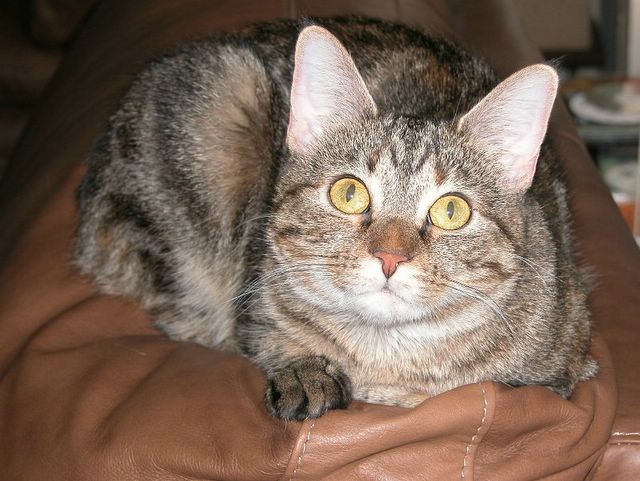
Ellie takes a brief break from causing mischief. . . to plot more mischief.
As always, you can see the best and latest pet pictures on Fridays at the Ark. Carnival of the Cats will be at When Cats Attack this Sunday.
Subscribe to:
Posts (Atom)
-
Last night I read Julian Barnes' The Sense of an Ending . Yes, the night before it went up against Donald Ray Pollock's The Devil Al...
-
As I said on New Year's Day, one of my projects for the year is to keep track of all the reading done by the characters in the fiction t...
-
 Anthony Trollope's 200th birthday takes place on April 24, and Karen at Books and Chocolate is hosting an Anthony Trollope Bicenntenni...
