Wednesday, November 02, 2005


A weird, lovely, fantastic object out of nature. . . has the curious ability to remind us--like rock and sunlight and wind and wilderness--that out there is a different world, older and greater and deeper by far than ours, a world which surrounds and sustains the little world of men as sea and sky surround and sustain a ship. The shock of the real. For a little while we are again able to see, as the child sees, a world of marvels. For a few moments we discover that nothing can be taken for granted, for if this . . . stone is marvelous then all which shaped it is marvelous, and our journey here on earth, able to see and touch and hear in the midst of tangible and mysterious things-in-themselves, is the most strange and daring of all adventures.

--Edward Abbey, Desert Solitaire

Tuesday, November 01, 2005

A reading catch-up post

On Beauty by Zadie Smith—While I read this because of the connection to Howards End, I have to say now that I wish Smith had broken free from the Forster template and allowed her story to develop a bit more organically. The ending in particular is obviously shoehorned and could have been stronger if it had evolved a bit more naturally. Plus, despite Smith's blatant talent, she's not on Forster's level, and it's a distraction to have that thought in mind while you're reading.

Also, the editing should have been completed before the book was published: "For Monty, though, Carlene wanted to get something 'really nice', and so they decided to brave three blocks of snow-walking in order to reach a fancier, smaller, specialist boutique that might have the cane with the carved handle which that Carlene had in mind."

The March by E.L. Doctorow—I've got to go back now and read all those Doctorow novels I've missed since reading Ragtime and The Book of Daniel twenty plus years ago.

Wild Parrots of Telegraph Hill by Mark Bittner—My plane book for the flight out to Utah. Finished it—in tears—the morning we drove out to the Swell. The documentary is being released on dvd on Dec. 27—I think that means it's intended to be my anniversary present this year.

The Night Thoreau Spent in Jail by Jerome Lawrence and Robert E. Lee—Hadn't read this one since high school and needed to reread it since S. will be reading it as part of our unit on Thoreau, so it was plane reading from Salt Lake to Minneapolis. Don't know if this one has continued to be performed through the years but if it hasn't, it's due for a revival.

The blog's already getting hits for quotes from The Night Thoreau Spent in Jail, so for those searching, here's a brief excerpt:

John: Welcome home. How's your overstuffed brain?

Henry. I've forgotten everything already.

John. At least you've got a diploma!

Henry. No, I don't.

John. Why not?

Henry. They charge you a dollar. And I wouldn't pay it.

John. But think how Mama would love it--your diploma from Harvard, framed on the wall!

Henry. Let every sheep keep his own skin.

Rising From the Plains by John McPhee—My first McPhee, unless you count daughter Martha. I made a stab at reading Basin and Range a few months back; I'll be returning to it now. This one's about geology in Wyoming and geologist David Love's Wyoming heritage. It's overdue, can't be renewed unless I switch it to S.'s card, yet I'm reluctant to return it to the library even though it's finished. I just like knowing it's readily available.

Still in progress: Desert Solitaire by Edward Abbey—On our drive from Torrey to the Swell, our wrangler (who part-times in the local bookstore) and our outfitter's co-owner discussed and argued the merits of Abbey's brand of environmentalism--when they weren't dealing with flat tires on the horse trailer and pointing out geological wonders and bald eagles and fielding questions on farming and ranching practices in the high country from the rest of us. Desert Solitaire is the Abbey our wrangler most recommends and I'll be posting selections from it in the days to come.

Also still in progress: Walden, a delightful asj fanfic offering from Karen Sumners, and, on audio, Ackroyd's The Lambs of London.

Saturday, October 29, 2005

Raising a revolution against the lie

Hovstad. The majority always has right on its side.

Billing. And truth too, by God!

Dr. Stockmann. The majority never has right on its side. Never, I say! That is one of these social lies against which an independent, intelligent man must wage war. Who is it that constitute the majority of the population in a country? Is it the clever folk or the stupid? I don't imagine you will dispute the fact that at present the stupid people are in an absolutely overwhelming majority all the world over. But good Lord!--you can never pretend that it is right that the stupid folk should govern the clever ones! (Uproar and cries.) Oh, yes--you can shout me down, I know! but you cannot answer me. The majority has might on its side--unfortunately; but right it has not. I am in the right--I and a few other scattered individuals. The minority is always in the right. (Renewed uproar.)

Hovstad. Aha!--so Dr. Stockmann has become an aristocrat since the day before yesterday!

Dr. Stockmann. I have already said that I don't intend to waste a word on the puny, narrow-chested, short-winded crew whom we are leaving astern. Pulsating life no longer concerns itself with them. I am thinking of the few, the scattered few amongst us, who have absorbed new and vigorous truths. Such men stand, as it were, at the outposts, so far ahead that the compact majority has not yet been able to come up with them; and there they are fighting for truths that are too newly-born into the world of consciousness to have any considerable number of people on their side as yet.

Hovstad. So the Doctor is a revolutionary now!

Dr. Stockmann. I propose to raise a revolution against the lie that the majority has the monopoly of the truth. What sort of truths are they that the majority usually supports? They are truths that are of such advanced age that they are beginning to break up. And if a truth is as old as that, it is also in a fair way to become a lie, gentlemen. (Laughter and mocking cries.) Yes, believe me or not, as you like; but truths are by no means as long-lived as Methuselah--as some folk imagine. A normally constituted truth lives, as we say, as a rule seventeen or eighteen, or at most twenty years; seldom longer. But truths as aged as that are always worn frightfully thin, and nevertheless it is only then that the majority recognises them and recommends them to the community as wholesome moral nourishment. There is no great nutritive value in that sort of fare, I can assure you; and, as a doctor, I ought to know. These "majority truths" are like last year's cured meat--like rancid, tainted ham; and they are the origin of the moral scurvy that is rampant in our communities.

--Henrick Ibsen, An Enemy of the People

Friday, October 28, 2005

But isn't what we experience when reading the Hebrew Bible or the New Testament the same as when we read Homer, Shakespeare, Cervantes, or Proust? Isn't the difference between the scriptures and worldly literature only social and political? The centuries-long polemics on the contrasts between poetry and faith can perhaps be reduced to the question of whether we should consider one poem or story holier than another. I have long since come to the conclusion that we can say with certainty that any powerful literary work is holy. And the opposite claim, that it is worldly, is equally valid. But it would be completely senseles to consider any great literary work holier or worldlier than another.

Fantastic interview with Harold Bloom in Eurozine.

"I stated writing fiction as kind of an exercise," he said. "There wasn't always a melody lying around, and I was really paranoid about writer's block. I had never tried to write anything but songs because I thought, 'I have an eighth-grade education, so I can't write anything but songs,' but then I thought, 'the only reason I'm not totally ignorant is that I read a lot.' I wrote a story, and then another."

And Steve Earle's play Karla has opened in New York. Bruce Weber talks to him about the play, the death penalty, writing fiction in prison, and his marriage to Allison Moorer.

Block

I place one word slowly
in front of the other,
like learning to walk again
after an illness.
But the blank page
with its hospital corners
tempts me.
I want to lie down
in its whiteness
and let myself drift
all the way back
to silence.

--Linda Pastan, Carnival Evening

Thursday, October 27, 2005


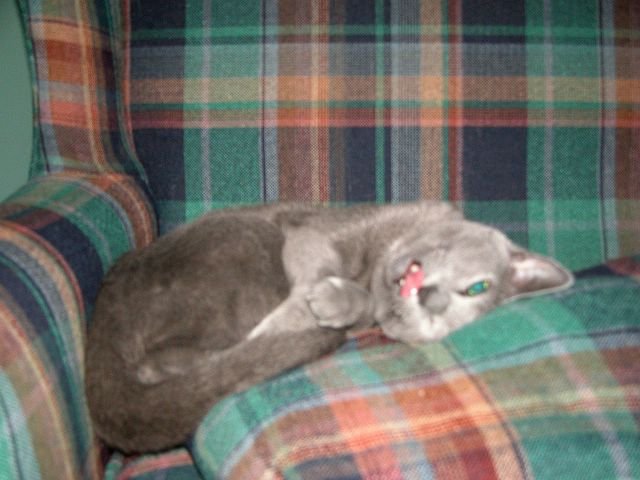
Claudie theatrically recounts his 36-day ordeal under the sofa after the introduction of terrorist kitten Ellie to the household: "And, and the worst part was: she kept peeking under there to look at me!"

I'm hoping he'll be back to form by Nov. 6 when he'll be needed to serve as a co-host for the 85th Carnival of the Cats. In the meantime, check out The Ark or Watermark for the latest and best pet blogging photos.

Happy MLK Jr. Day!

This morning I took our senior cat Charlie to the vet for his monthly arthritis shot. L. ordered an induction range (on sale!) for our retir...